

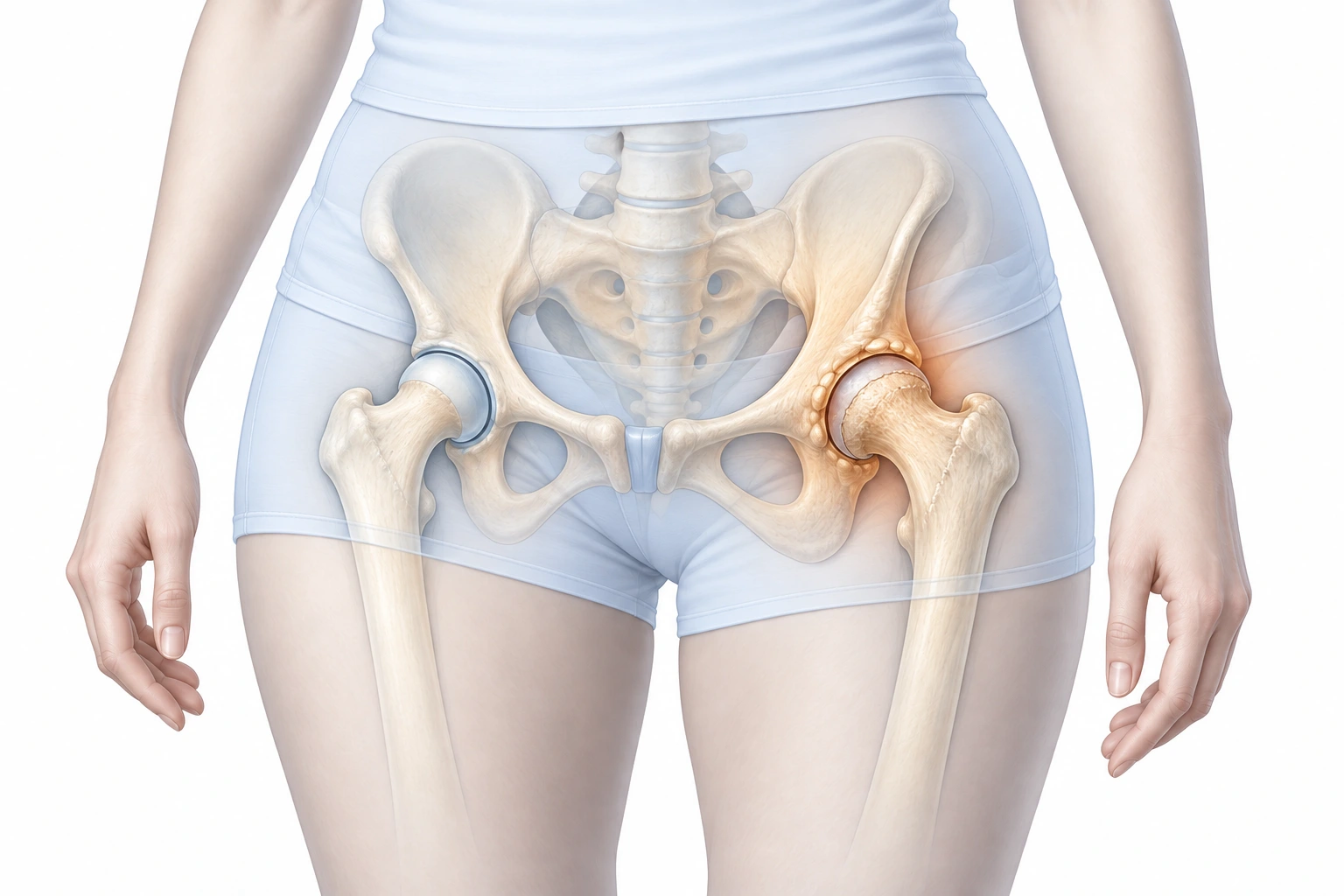
The hip is a ball-and-socket joint. Smooth cartilage covers the femoral head and the socket, allowing them to move with little friction. In osteoarthritis, cartilage becomes thinner and the joint changes over time. Bone spurs may develop, and movement can become painful or restricted.
What does it feel like?
Hip arthritis often causes pain in the groin or front of the thigh. Some people feel it in the buttock or knee. Stiffness after sitting, difficulty putting on socks, and discomfort with walking or getting into a car are common complaints. Symptoms do not always match the severity seen on an X-ray.
Finding the pain source
A careful examination helps determine whether pain comes from the hip joint, surrounding tendons, the lower back, or more than one source. Your clinician checks hip motion, walking, strength, and nerve function. X-rays usually provide the initial assessment of joint space and bone changes. MRI is not routinely needed for straightforward osteoarthritis.
Treatment and everyday movement
Treatment starts with the activities that matter to you. An exercise program can improve strength and mobility without repeatedly provoking symptoms. Cycling, pool exercise, and appropriately paced walking may be useful. Weight management, when relevant, and a cane used on the opposite side can reduce joint loading.
Medication choices depend on your health history, including kidney, stomach, and cardiovascular risks. An image-guided corticosteroid injection may provide temporary relief, but it does not restore cartilage. Hyaluronic acid injections are not recommended for hip osteoarthritis because benefit over placebo has not been established.
When to consider surgery
When pain and restricted function remain substantial despite nonsurgical treatment, an orthopedic consultation can help you consider hip replacement. The decision depends on symptoms, examination, imaging, goals, and surgical risks.
When to seek help
Seek prompt assessment for sudden severe pain, fever, or inability to bear weight, particularly after a fall. Not every painful hip has arthritis, and a clear diagnosis guides the next step.