

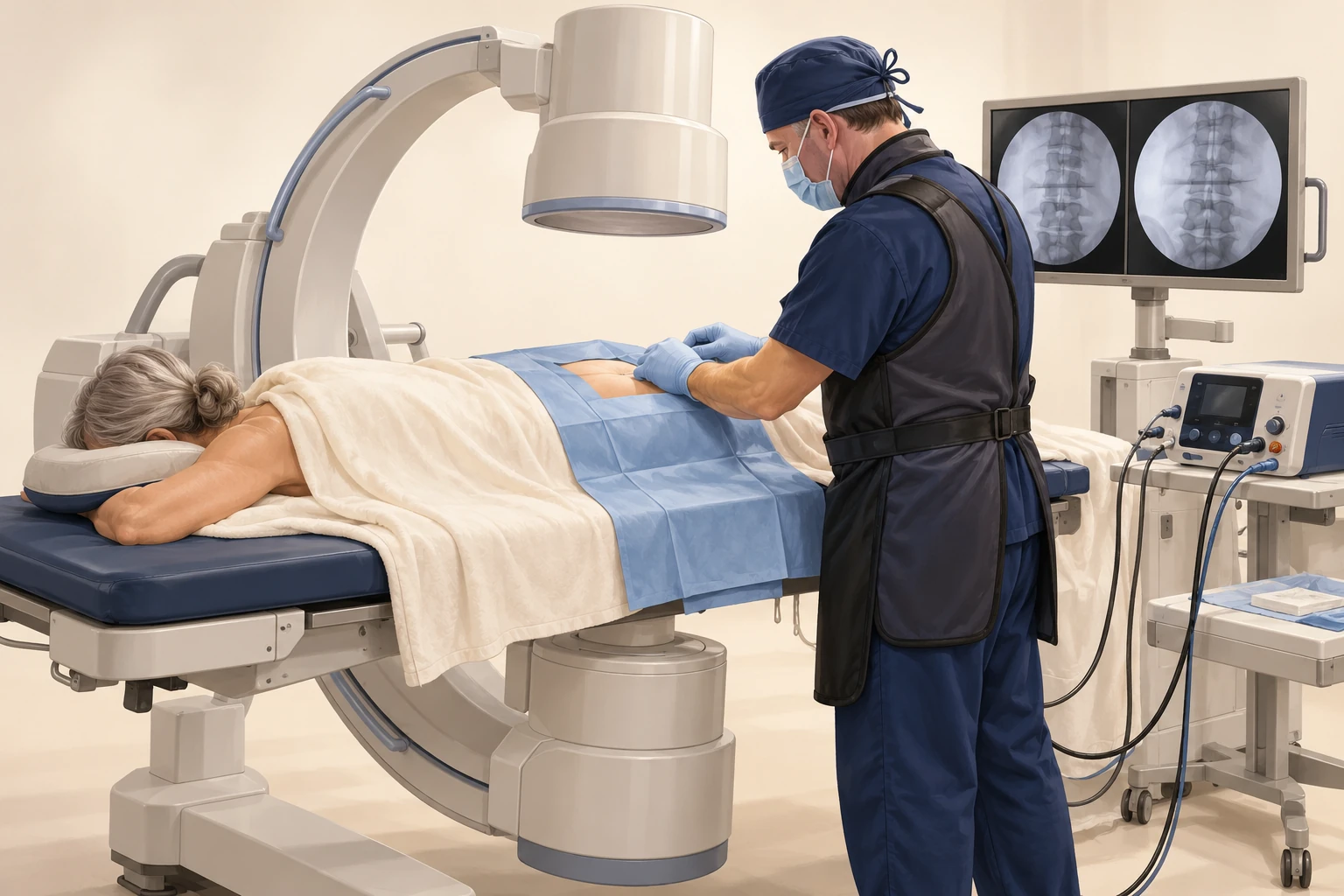
Radiofrequency ablation, or RFA, uses controlled heat to interrupt signals carried by selected nerves. For pain arising from the small facet joints at the back of the spine, the targets are nearby nerves called medial branches. The treatment does not remove the joint or reverse arthritis. [1]
Before recommending RFA, your physician needs to assess whether those joints are contributing to your pain. Arthritis on an MRI does not answer that question by itself. A medial branch block places numbing medicine around the nerves. Substantial temporary relief during activities that usually hurt helps determine whether RFA is worth considering. A second block may be required. [1, 2]
During treatment, you lie on your stomach while the physician uses X-ray guidance to position specialized needles alongside the target nerves. After checking placement and giving numbing medicine, an electrode delivers radiofrequency energy. You usually go home the same day. [3]
Relief may develop gradually over several weeks. Some people gain months of improvement; others have little benefit. The nerves can recover, so pain may return. Repeating treatment may be reasonable when the first procedure provided meaningful, lasting relief. [1, 2]
Soreness or a temporary burning sensation can occur afterward. Bleeding, infection, and unintended nerve injury are possible. These nerves also supply small spinal muscles, which is one reason careful selection and rehabilitation matter. [1, 3]
Facet RFA treats a particular source of pain. Disc pain, nerve-root pain, and spinal stenosis need their own assessment.
Takeaway: Before RFA, ask: “What did my diagnostic blocks show, and which part of my pain do we expect this treatment to help?”
References and further reading
- American Society of Pain and Neuroscience. Latest Evidence-Based Application for Radiofrequency Neurotomy (LEARN): Best Practice Guidelines. 2021.
- American Society of Interventional Pain Physicians. An Algorithmic Approach to Facet Joint Interventions.
- MedlinePlus, National Library of Medicine. Radiofrequency ablation for chronic pain. Reviewed January 16, 2025.