

Evidence reviewed through October 26, 2026.
What does it treat?
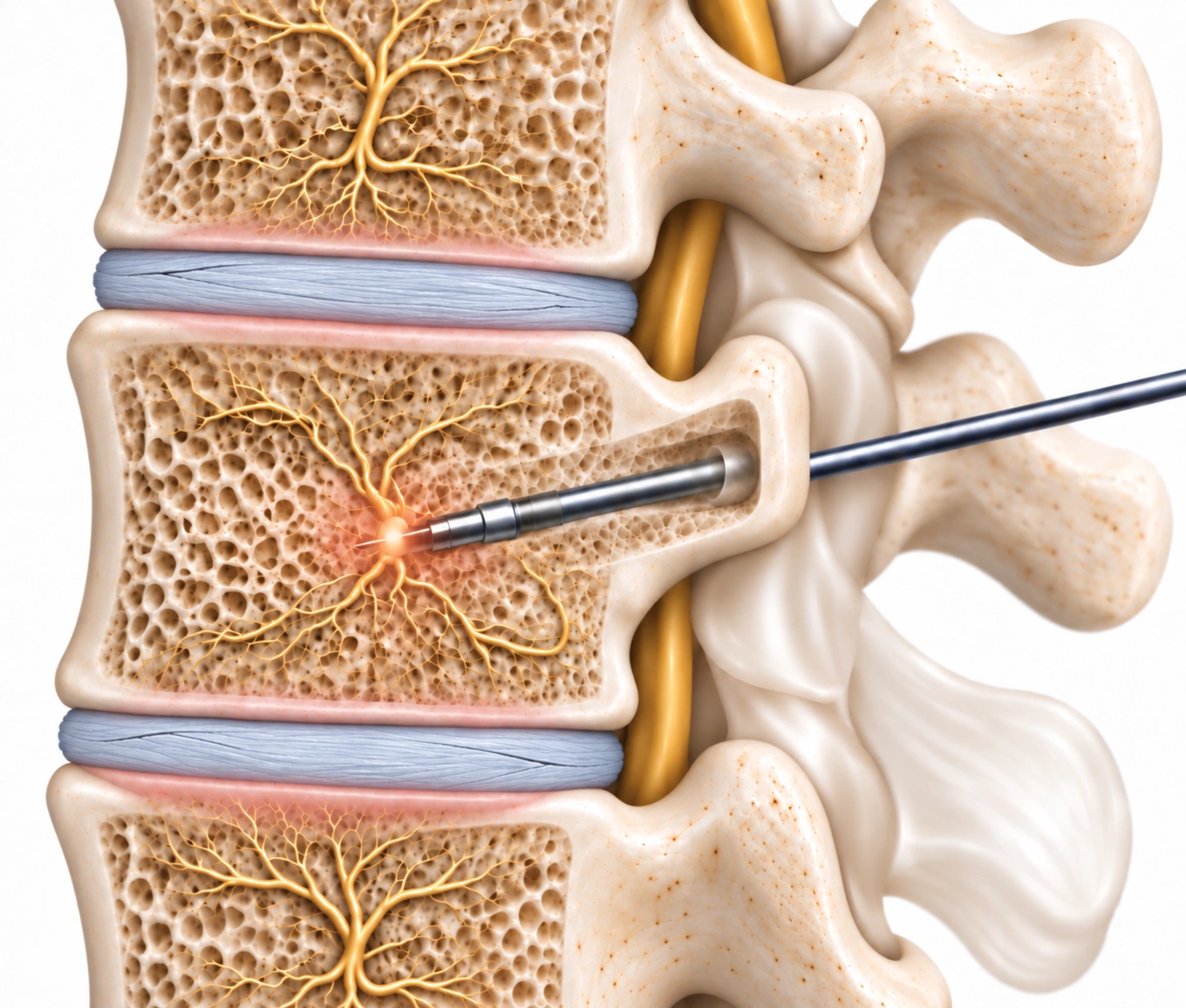
Basivertebral nerve ablation, or BVNA, treats a particular form of persistent low back pain called vertebrogenic pain. The vertebral endplates separate each disc from the adjacent spinal bones. Damage and inflammation in this region can generate pain carried by the basivertebral nerve inside the vertebral body. Typical complaints include deep central low back pain with sitting, bending, lifting, or transitions between positions. These features support an evaluation but do not confirm the diagnosis. [1,7]
MRI findings called Modic type 1 or type 2 changes are part of the selection process. They show changes in bone marrow next to the endplates. They are not a diagnosis by themselves: facet arthritis, disc disease, stenosis, hip problems, and muscle dysfunction can coexist. The examination and symptom pattern must fit the proposed target.
How does it work?
A radiofrequency probe heats a controlled region around the basivertebral nerve within the painful vertebral body. Reducing its ability to transmit pain may allow more comfortable movement. This is different from medial branch RFA, which targets nerves outside the vertebra supplying the facet joints. BVNA does not rebuild the disc, remove a herniation, enlarge the spinal canal, or stabilize an unstable segment. [1,2]
The evidence largely concerns a specific intraosseous ablation system and carefully defined vertebrogenic pain. It should not be generalized to every treatment described as disc ablation, endplate treatment, or radiofrequency therapy.
Who may benefit?
Trials generally enrolled adults with at least six months of low back pain despite nonsurgical treatment and qualifying Modic changes at L3 through S1. Clinicians also consider disability, treatment history, bone quality, and competing pain sources. Unlike facet RFA, routine diagnostic medial branch blocks do not establish suitability for BVNA. They address a different pain pathway. [1,2,7]
Predominant radiating leg pain, symptomatic nerve compression, infection, fracture, tumor, and substantial instability warrant another evaluation. Previous surgery is not a single yes-or-no rule: eligibility depends on the operation, current symptoms, anatomy, and whether the proposed treatment is supported in that setting. Severe osteoporosis and altered pedicle anatomy require particular attention.
What happens during treatment?
The team reviews MRI images, medications, bleeding risk, prior operations, and anesthesia needs. Treatment is usually performed in an ambulatory surgery center or hospital outpatient setting with sedation or general anesthesia, depending on the patient and facility. Medication and fasting instructions are individualized.
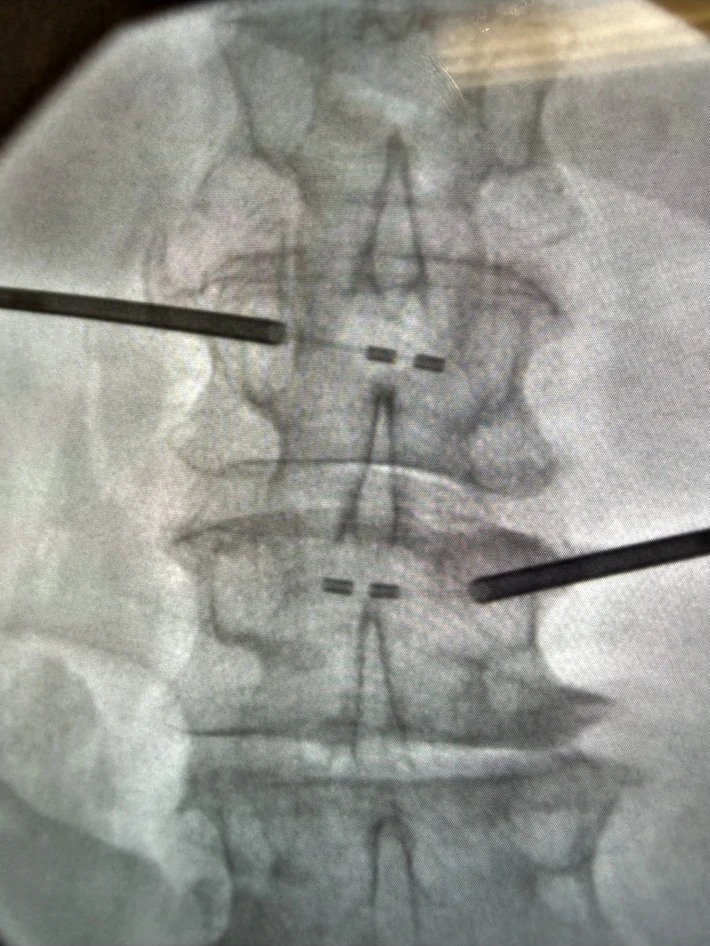
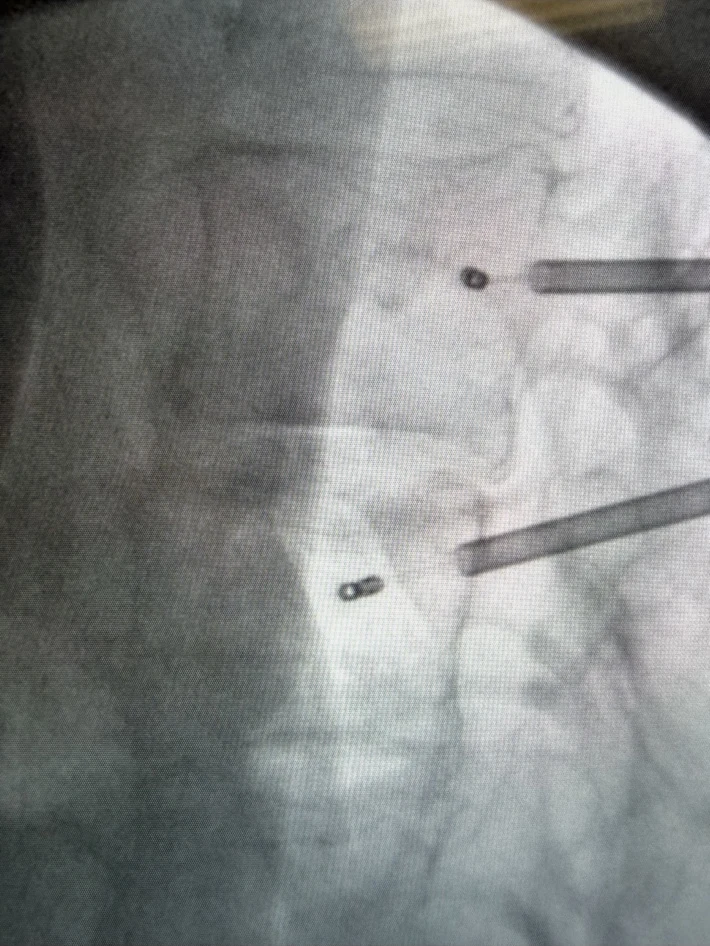
With the patient face down, the clinician uses fluoroscopy to guide an access instrument through a small incision and into the vertebral body, commonly through a pedicle. A channel is made toward the intended nerve location, the probe is positioned, and a controlled thermal treatment is delivered. More than one vertebral body may require treatment. Instruments are removed and the small wounds dressed. [1,2,7]
Basivertebral nerve ablation on fluoroscopy
What does the research show?
The SMART trial randomized 225 patients to BVNA or a sham procedure. At three months, disability on the 100-point Oswestry Disability Index, or ODI, improved by 20.5 points with BVNA and 15.2 with sham in the per-protocol analysis. The additional improvement was approximately 5.3 points, smaller than the total improvement experienced by the treated group. This illustrates why improvement after treatment and benefit attributable to treatment are different questions. [1]
INTRACEPT randomized 140 patients to BVNA or standard care. At three months, the between-group differences favored BVNA by 20.3 ODI points and 2.5 points on a ten-point pain scale. Those differences are more likely to matter in daily life than a small statistically significant change. However, this comparison was open-label, and standard care was not a sham procedure. [2,3]
Two-year treatment-arm follow-up and a separate five-year SMART follow-up reported continuing improvement. A 2024 pooled analysis obtained five-year assessments from 249 of 320 treated participants. Among those assessed, 65.5% reported at least 50% pain reduction. There was no untreated comparison group at that stage; missing follow-up and subsequent care limit interpretation. [4,5,6]
Systematic review and professional guidance support BVNA for appropriately selected vertebrogenic pain, while noting that much of the evidence comes from related trial populations. Several pivotal studies were sponsored by Relievant Medsystems, the system manufacturer, and some investigators reported financial relationships. These disclosures matter when weighing reproducibility and independent confirmation. [7,8]
Benefits, limitations, and risks
The practical goal is less pain during meaningful activity, with better sitting tolerance, movement, sleep, or rehabilitation participation. Benefit is not guaranteed, and improvement may take weeks to months. Persistent pain can reflect an incorrect target or several simultaneous sources. Evidence for repeating BVNA after an unsuccessful procedure is less developed than evidence for the initial treatment. [5,6,7,8]
Risks include wound pain, bleeding, infection, anesthesia complications, temporary leg symptoms, unintended nerve injury, and vertebral fracture. Risk depends partly on bone quality and the access path. Published trial safety results should not be treated as a universal complication rate for older adults, osteoporosis, instrumentation, or substantially different techniques.
Recovery, alternatives, and sequencing
Most patients return home after monitoring. Walking and basic activity usually resume gradually. Lifting, bending, wound care, driving, and return to work should follow the treating team’s instructions rather than a fixed online timetable. Follow-up should record specific activities as well as pain scores.
Exercise, medication when appropriate, and rehabilitation remain important. Facet treatment, decompression, or other procedures may make more sense when another source dominates. BVNA should address a supported endplate pain diagnosis rather than simply an abnormal MRI. New weakness, bowel or bladder changes, fever, or worsening wound symptoms require prompt assessment.
Questions to ask your physician
- Do my symptoms and MRI support vertebrogenic pain?
- Which other pain sources have been considered?
- How does the research apply to my prior surgery and bone health?
- What functional improvement should we measure, and when?
- What is the plan if treatment does not help?
References
- Fischgrund JS, et al. Intraosseous basivertebral nerve ablation: a prospective randomized double-blind sham-controlled multi-center study. European Spine Journal. 2018. PubMed.
- Smuck M, et al. Prospective, randomized, multicenter study of intraosseous basivertebral nerve ablation: 12-month results. Regional Anesthesia and Pain Medicine. 2021;46:683–693. DOI.
- Khalil JG, et al. A prospective, randomized, multicenter study of intraosseous basivertebral nerve ablation for chronic low back pain. Spine Journal. 2019;19:1620–1632. PubMed.
- Koreckij T, et al. Prospective, randomized, multicenter study of intraosseous basivertebral nerve ablation: 24-month treatment arm results. North American Spine Society Journal. 2021. PubMed.
- Fischgrund JS, et al. Long-term outcomes following intraosseous basivertebral nerve ablation: 5-year treatment arm results. European Spine Journal. 2020. PubMed.
- Intraosseous basivertebral nerve ablation: A 5-year pooled analysis from three prospective clinical trials. Interventional Pain Medicine. 2024. PubMed.
- Sayed D, et al. Best Practice Guidelines on the Diagnosis and Treatment of Vertebrogenic Pain with Basivertebral Nerve Ablation from ASPN. Journal of Pain Research. 2022. PubMed.
- Conger A, et al. The effectiveness of intraosseous basivertebral nerve radiofrequency ablation: an updated systematic review with single-arm meta-analysis. Pain Medicine. 2022;23:S50–S62. DOI.