

Evidence reviewed through October 26, 2026.
What does it treat?
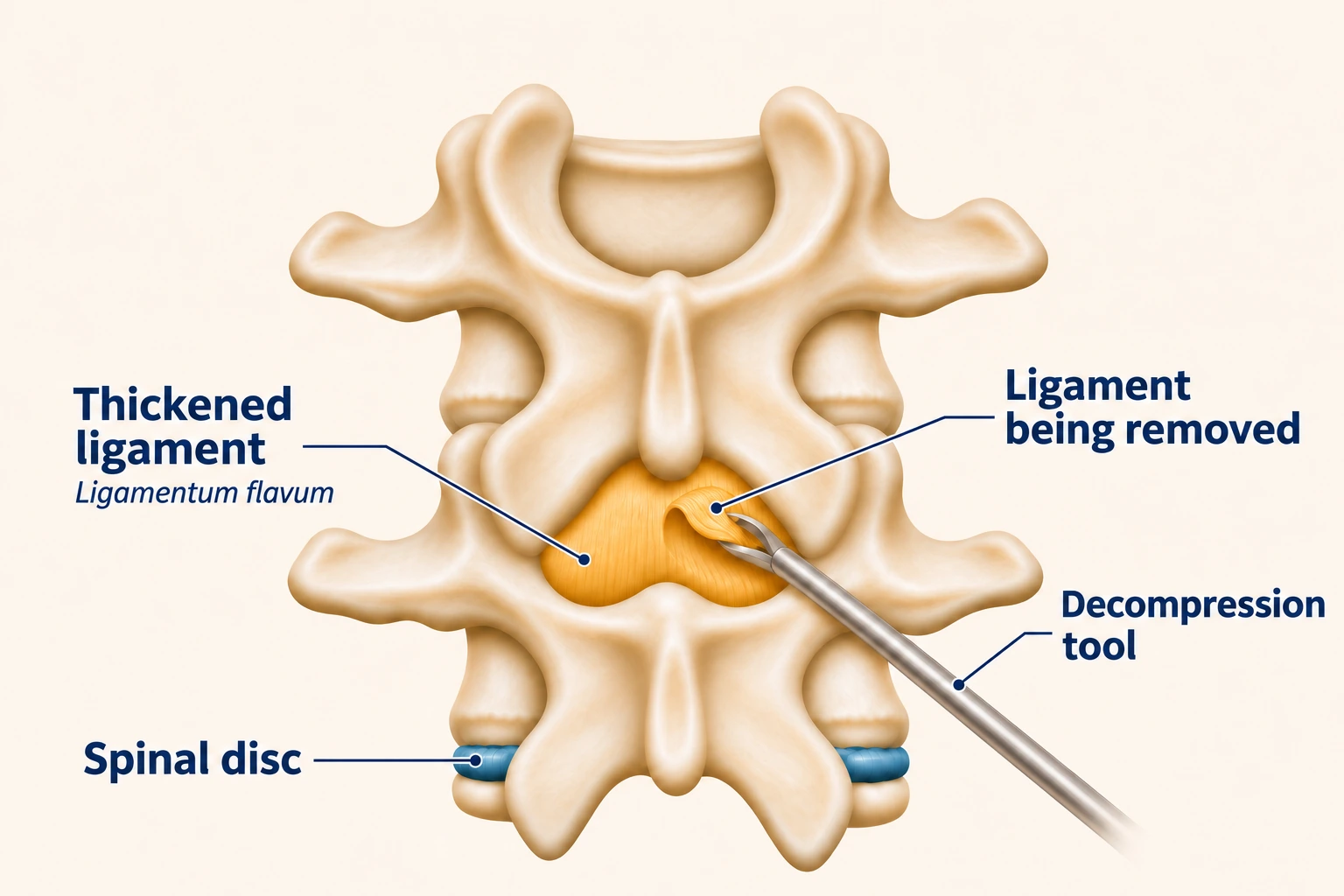
MILD is a form of percutaneous image-guided lumbar decompression for selected patients with spinal stenosis. It addresses narrowing caused partly by a thickened ligamentum flavum, the ligament along the back of the spinal canal. The characteristic symptom is neurogenic claudication: aching, heaviness, numbness, or cramping in the buttocks or legs with standing and walking, often relieved by sitting or leaning forward. [1,7]
An MRI showing stenosis is not sufficient. Some people have substantial narrowing without limiting symptoms. The clinician must match the imaging to the examination and walking pattern and consider vascular disease, hip arthritis, neuropathy, and other causes. The amount and location of ligament thickening matter because MILD treats only part of the narrowing.
How does it work?
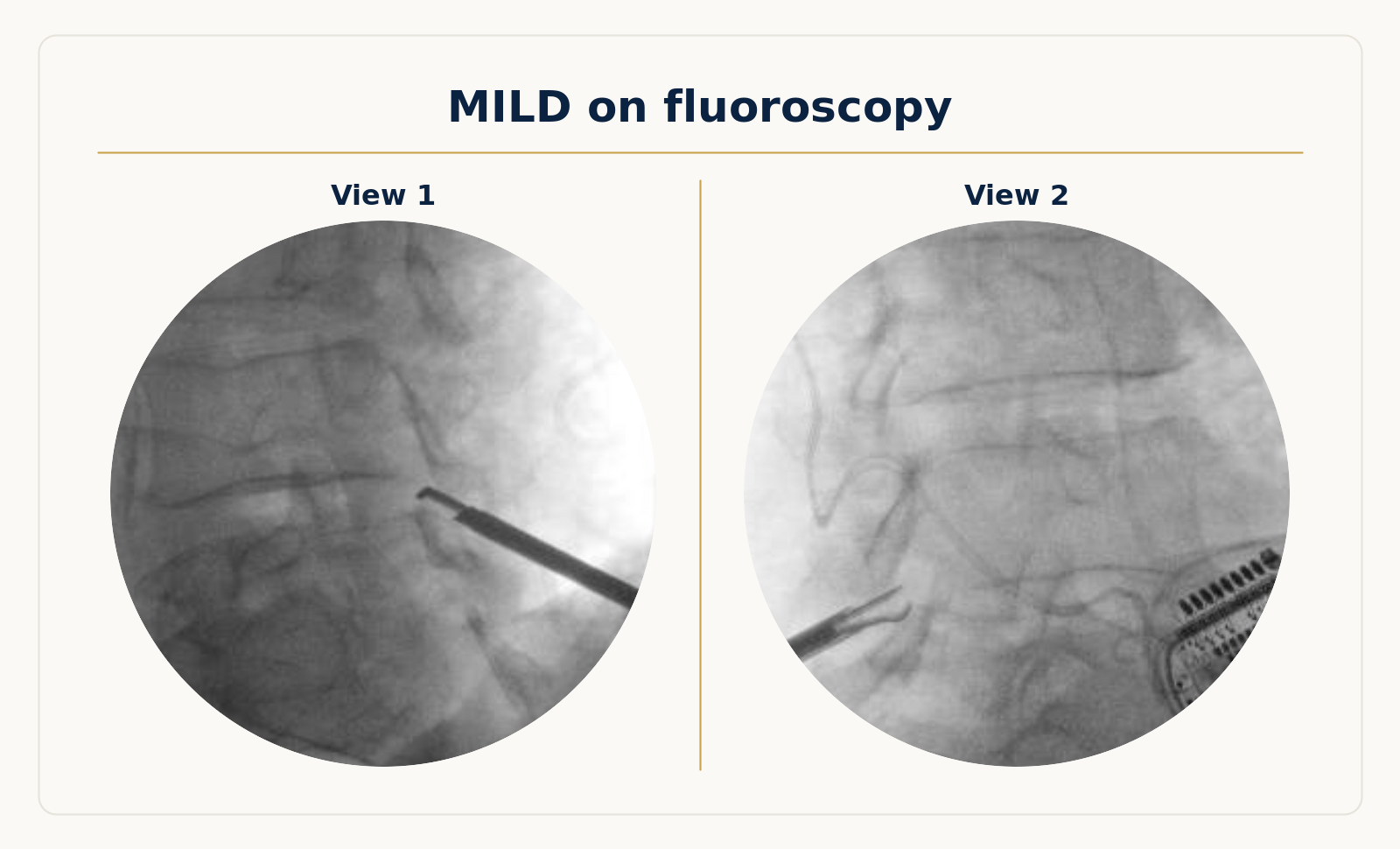
Through a small opening, the clinician removes limited bone to obtain access and reduces excess ligament tissue. The aim is to create more room for neural structures without placing an implant. Fluoroscopy guides instrument placement; the procedure is not the same as open or endoscopic laminectomy. [1,7]
MILD does not remove a large disc herniation, correct a spinal slip, or comprehensively treat every bony narrowing. It also does not directly treat peripheral neuropathy. Understanding what remains untreated is essential when several abnormalities contribute to symptoms.
Who may benefit?
Patients are considered when claudication limits activity despite appropriate nonsurgical care and imaging confirms that hypertrophic ligamentum flavum contributes to central canal stenosis. Evaluation includes strength, sensation, gait, balance, pulses when relevant, previous surgery, and spinal stability. Clinicians should establish a practical baseline such as distance walked before stopping. [1,2,7]
A diagnostic facet block is not a routine eligibility test for MILD. It evaluates facet pain, not canal crowding. A prior epidural response may provide context but does not prove that removing ligament will help.
Progressive weakness, bowel or bladder dysfunction, severe instability, another dominant compressive lesion, infection, or unsuitable access anatomy can change the treatment pathway. Previous surgery at the intended access level requires careful review. A surgical opinion may be appropriate when broader decompression is needed.
What happens during treatment?
The team reviews imaging and discusses anticoagulants, diabetes treatment, allergies, and anesthesia. MILD is usually outpatient, with local anesthesia and light sedation when suitable. Patients generally lie face down. Fasting and transportation requirements follow the facility’s plan.
Using X-ray guidance, the clinician places an access device through a small incision, removes limited obstructing bone when necessary, and debulks thickened ligament. The extent depends on the anatomy and levels treated. No spacer or fusion implant remains. The patient is observed afterward, with assessment of symptoms and neurologic function before discharge. [1,3,7]
What does the research show?
MiDAS ENCORE randomized 302 patients to MILD or epidural steroid injection; 143 MILD and 131 injection recipients were included in the treated groups described in the two-year publication. The randomized comparison favored MILD for disability and symptom outcomes at one year. The two-year extension followed the MILD arm, so its durability findings should not be read as an ongoing randomized comparison. [1,2]
At two years, the MILD group’s mean ODI disability improvement was 22.7 points and mean pain improvement was 3.6 points. These are changes from baseline rather than differences against a continuing control group. They suggest meaningful improvement among followed patients but do not show that every patient responds. [2]
MOTION enrolled 155 participants and compared MILD plus conventional medical management with conventional management alone. At one year, average walking time to severe symptoms improved by 258% with MILD plus management versus 64% with management alone. This objective walking outcome is useful, although percentage gains depend on the starting walking time and should not be interpreted as miles or unrestricted walking. [3]
Two-, three-, and five-year MOTION reports describe sustained improvement among followed participants. Later follow-up involved smaller treatment cohorts, and crossover and loss to follow-up weaken the original comparison. These are extensions of one trial, not several independent randomized trials. [4,5,6]
The 2025 systematic review and MIST guidance place MILD within a selection-based stenosis pathway. Major trials were sponsored by Vertos Medical, and several investigators reported industry relationships. Open-label treatment and differing usual care can influence reported benefits. The evidence does not establish that MILD is preferable to laminectomy for every patient with stenosis. [7,8]
Benefits, limitations, and risks
Potential benefits include longer standing and walking tolerance, less leg discomfort, and greater participation in exercise. Back pain may improve, remain unchanged, or have a separate source. The procedure may be incomplete treatment when bone, discs, instability, or foraminal narrowing are major contributors.
Possible harms include soreness, bruising, bleeding, infection, dural injury or cerebrospinal fluid leak, unintended nerve injury, and inadequate decompression. Some patients later require injections or surgery. Trial reports cannot exclude rare serious events, and complication rates from other decompression operations should not be substituted for MILD-specific data. [2,7,8]
Recovery, alternatives, and sequencing
Most patients go home after monitoring and begin short walks as advised. Progress is assessed over weeks through activity tolerance, strength, balance, and pain. Wound care, lifting, driving, and return to work depend on the individual procedure and recovery. Rehabilitation should rebuild endurance gradually rather than immediately test the maximum walking distance.
Alternatives include exercise-based care, medication, selected epidural injections, interspinous devices, and surgical decompression, with fusion reserved for appropriate structural indications. Each addresses different anatomy and carries different burdens. New weakness, bowel or bladder changes, fever, or rapidly worsening pain require prompt assessment.
Questions to ask your physician
- How much of my narrowing comes from ligament thickening?
- What other causes of walking difficulty have been considered?
- Why MILD rather than an injection or surgical decompression?
- What walking goal should we measure after treatment?
- What remains available if symptoms persist?
References
- Benyamin RM, Staats PS. MILD is an effective treatment for lumbar spinal stenosis with neurogenic claudication: MiDAS ENCORE randomized controlled trial. Pain Physician. 2016. PubMed.
- Staats PS, et al. Long-term safety and efficacy of minimally invasive lumbar decompression: 2-year results of MiDAS ENCORE. Regional Anesthesia and Pain Medicine. 2018;43:789–794. PubMed.
- Deer TR, et al. The MOTION Study: a randomized controlled trial with objective real-world outcomes: one-year results. Pain Medicine. 2022. PubMed.
- The MOTION study: two-year results of a real-world randomized controlled trial of the mild procedure for lumbar spinal stenosis. Pain Practice. 2024. PubMed.
- Three-year results of the MOTION randomized controlled trial for lumbar spinal stenosis using the percutaneous mild procedure. Interventional Pain Medicine. 2025. DOI.
- The MOTION randomized controlled trial for lumbar spinal stenosis using the percutaneous mild procedure: 5-year results. Interventional Pain Medicine. 2026;5:100768. PubMed.
- Deer TR, et al. Best Practices for Minimally Invasive Lumbar Spinal Stenosis Treatment 2.0 (MIST): ASPN consensus guidance. Journal of Pain Research. 2022;15:1325–1354. DOI.
- Minimally Invasive Lumbar Decompression (MILD) in Patients with Lumbar Spinal Stenosis: A Systematic Review of Randomized and Prospective Trials. Journal of Pain Research. 2025. DOI.