

Evidence reviewed through October 26, 2026.
What does it treat?
Vertebral augmentation treats selected painful vertebral compression fractures. Osteoporosis is a common cause, although cancer and other disorders can also weaken a vertebra. A fracture may cause focal pain with standing, walking, turning in bed, or transfers. Older collapsed vertebrae may be painless, so the presence of a wedge-shaped bone does not itself justify treatment. [1,4,5]
Evaluation matches focal tenderness and symptoms to imaging. MRI can show marrow edema suggesting an active fracture, while CT may clarify bone anatomy and posterior wall involvement. The clinician also looks for nerve compression, infection, malignancy, and other pain sources. A fracture-related treatment should target a supported fracture diagnosis rather than generalized back pain.
How do the procedures differ?
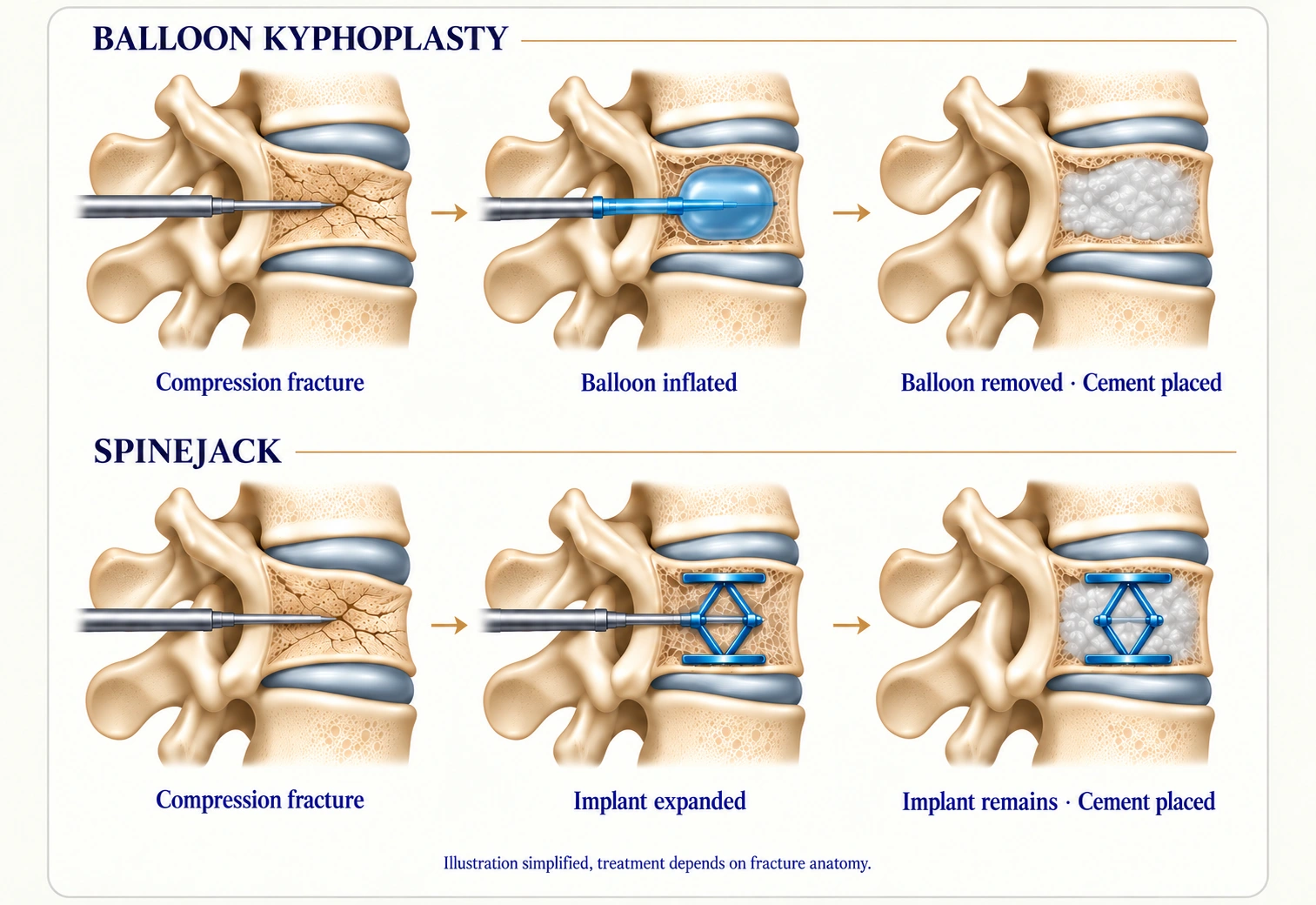
Vertebroplasty places medical bone cement into the fractured vertebral body to stabilize it. Balloon kyphoplasty first creates a cavity and may partly restore height before cement delivery. SpineJack uses expandable titanium implants to help reduce and support the fracture, followed by cement. The implants remain in the bone. [1,2,3]
Height correction can be useful in selected fractures, but a better-looking X-ray does not necessarily mean better pain relief or function. None of these procedures cures osteoporosis, guarantees restoration of the original vertebral shape, or treats every cause of spinal deformity. They are different from decompression or instrumented fusion.
Who may benefit?
Candidates have a fracture that convincingly explains limiting pain and a reasonable expectation that stabilization will improve mobility. Many fractures improve with time, analgesia, appropriate bracing, and rehabilitation. Treatment urgency depends on pain severity, inability to mobilize, fracture age, medical vulnerability, and response to nonsurgical care. A fixed waiting period is not appropriate for every patient. [1,4,5]
Major neurologic deficit, significant canal compromise, infection, uncorrected bleeding risk, or an unstable injury can require a different approach. Cancer-related fractures need assessment of tumor treatment and structural risk; evidence from osteoporosis trials does not automatically apply. Bone quality, adjacent fractures, and anesthesia tolerance also influence planning.
What happens during treatment?
Augmentation is generally performed in a surgery center or hospital with local anesthesia plus sedation or general anesthesia. The patient lies face down. Fluoroscopy guides access instruments into the fractured vertebra through a small skin opening. Balloon or implant steps depend on the chosen technique, followed by controlled cement placement and monitoring for leakage. [1,2,3]
The clinician reviews fracture configuration, cement risks, medications, and possible biopsy when the diagnosis is uncertain. After treatment, monitoring includes pain, neurologic function, and safe mobilization. Discharge timing depends on medical condition and the procedure rather than a universal outpatient promise.
What does the research show?
FREE randomized 300 patients to balloon kyphoplasty or nonsurgical management. At one month, improvement in the SF-36 physical health score favored kyphoplasty by about five points. The study supported faster functional improvement, but it was not blinded and was industry-sponsored. It compared a procedure with nonsurgical care, not a sham operation. [1]
KAVIAR treated 381 randomized patients with kyphoplasty or vertebroplasty and followed outcomes through two years. Pain and disability improved similarly. Kyphoplasty had less cement leakage on CT, but the study ended before its intended enrollment and did not establish a significant difference in later fracture incidence. Imaging leakage also differs from symptomatic injury. [2]
SAKOS compared SpineJack with balloon kyphoplasty; 141 patients underwent treatment and 126 completed twelve-month follow-up. It supported noninferiority of the implant approach on its primary composite endpoint and reported some favorable secondary outcomes. This was an active-treatment, manufacturer-sponsored comparison. It does not prove that every fracture needs an implant or that height restoration guarantees superior everyday function. [3]
Sham-controlled vertebroplasty evidence is conflicting. VAPOUR enrolled 120 patients with severe pain from recent fractures. At fourteen days, pain below four out of ten occurred in 44% after vertebroplasty versus 21% after placebo. VERTOS IV randomized 180 patients with acute osteoporotic fractures and found no significant pain advantage over sham through twelve months. Patient severity, timing, and sham methods differed. [4,5]
Two landmark 2009 sham-controlled trials also failed to show a clear routine benefit, and the 2018 Cochrane review did not support routine vertebroplasty for osteoporotic fractures. These findings argue for careful selection and an explicit discussion of uncertainty. They should not be hidden by citing only favorable uncontrolled series. [6,7,8]
The 2025 NASS guideline summary provides another framework for matching treatment to fracture symptoms and imaging. Its recommendations should be read with their evidence grades and populations rather than interpreted as a recommendation to augment every compression fracture. [9]
Benefits, limitations, and risks
A meaningful benefit is being able to get out of bed, walk, breathe comfortably, and resume basic care with less pain. Some patients improve rapidly, others gradually, and some do not improve. Persistent pain may arise from another fracture or from joints, muscles, or nerves. Observational survival associations should not be presented as proof that augmentation prolongs life.
Risks include cement leakage, bleeding, infection, worsening pain, embolism, unintended nerve or spinal cord injury, and anesthesia complications. Cement outside the vertebra is often asymptomatic, but leakage into sensitive structures can be serious. New fractures can occur because osteoporosis persists; whether a particular procedure changes adjacent-fracture risk remains a separate evidence question. [2,4,8]
Recovery, alternatives, and sequencing
The team guides walking, wound care, lifting, and return to activity. Follow-up should assess mobility, pain, new symptoms, and the need for rehabilitation. New weakness, bowel or bladder changes, chest pain, breathlessness, fever, or escalating pain requires urgent assessment.
Nonsurgical care remains appropriate for many fractures. Decompression or fixation may be needed for instability or neurologic compromise. Regardless of augmentation, osteoporosis evaluation, fracture-prevention medication when indicated, fall prevention, nutrition, and strength and balance training remain essential. Stabilizing one fracture should be part of preventing the next one rather than the end of treatment.
Questions to ask your physician
- What shows that this fracture is causing my pain now?
- Why this procedure rather than continued nonsurgical care?
- Does balloon or implant use offer a meaningful advantage in my fracture?
- How do the conflicting sham trials affect the recommendation?
- What is my osteoporosis and future-fracture prevention plan?
References
- Wardlaw D, et al. Efficacy and safety of balloon kyphoplasty compared with nonsurgical care: the FREE randomized trial. Lancet. 2009;373:1016–1024. PubMed.
- Dohm M, et al. A randomized trial comparing balloon kyphoplasty and vertebroplasty for osteoporotic vertebral compression fractures. AJNR. 2014;35:2227–2236. DOI.
- Noriega DC, et al. Randomized noninferiority comparison of an implantable titanium vertebral augmentation device and balloon kyphoplasty: SAKOS. Spine Journal. 2019;19:1782–1795. DOI.
- Clark W, et al. Safety and efficacy of vertebroplasty for acute painful osteoporotic fractures: VAPOUR. Lancet. 2016. PubMed.
- Firanescu CE, et al. Vertebroplasty versus sham procedure for painful acute osteoporotic vertebral compression fractures: VERTOS IV. BMJ. 2018;361:k1551. PubMed.
- Buchbinder R, et al. A randomized trial of vertebroplasty for painful osteoporotic vertebral fractures. New England Journal of Medicine. 2009;361:557–568. DOI.
- Kallmes DF, et al. A randomized trial of vertebroplasty for osteoporotic spinal fractures. New England Journal of Medicine. 2009;361:569–579. DOI.
- Buchbinder R, et al. Percutaneous vertebroplasty for osteoporotic vertebral compression fracture. Cochrane Database of Systematic Reviews. 2018;CD006349. PubMed.
- Cho CH, et al. Guideline summary review: an evidence-based clinical guideline for the diagnosis and treatment of adults with osteoporotic vertebral compression fractures. Spine Journal. 2025. DOI.