

Evidence reviewed through October 26, 2026.
What do these procedures treat?
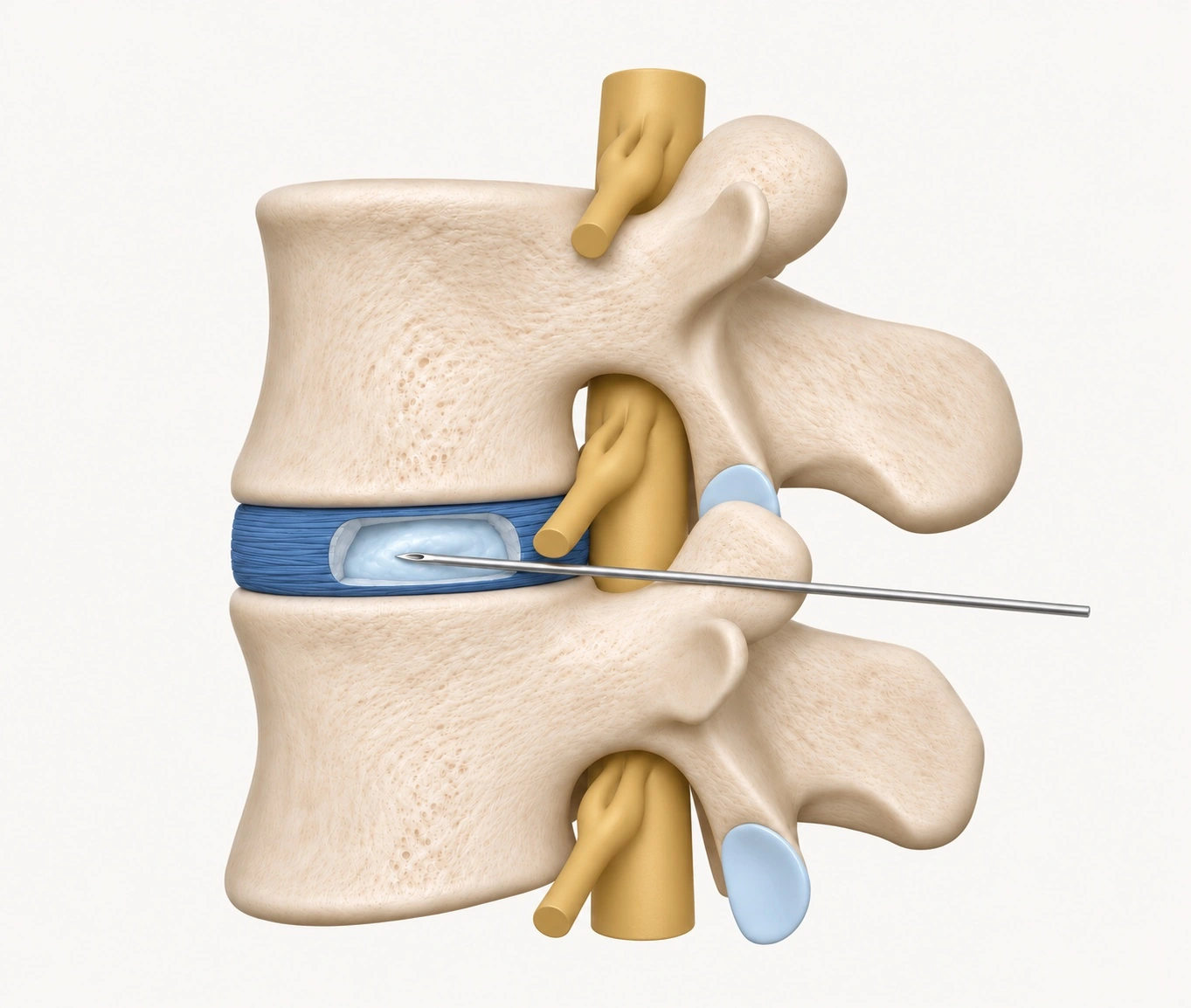
Intradiscal procedures place a selected preparation inside an intervertebral disc for suspected discogenic low back pain. A disc contains a tough outer annulus and a softer nucleus pulposus. Degeneration and annular injury can be associated with pain, but a worn disc on MRI is common and does not establish that it is the source. Endplate, facet, nerve, muscle, and SI joint pain may overlap. [1,2]
Evaluation considers symptoms, examination, imaging, and previous treatment. Provocative discography has been used in some research protocols, but it is invasive and imperfect and is not automatically required or appropriate for every patient. The proposed diagnosis should remain open to competing explanations.
How do the treatments differ?
Platelet-rich plasma, or PRP, is prepared from the patient’s blood. Its components are intended to influence inflammation and tissue signaling. Processing methods, platelet and white-cell concentrations, and injected materials vary. One PRP preparation cannot be assumed equivalent to another. [1,2]
Nucleus pulposus allograft supplementation uses processed donor disc tissue. VIA Disc NP differs from the older viable-cell-containing VIA Disc Matrix evaluated in VAST. Mesenchymal cell and disc progenitor cell treatments are additional, distinct approaches. Results from one product cannot establish effectiveness for another. None should be described as a proven general method to regrow a normal disc. [3,4,5,6,7]
Who may benefit?
Research has generally focused on adults with persistent axial back pain, selected degrees of disc degeneration, and inadequate improvement after nonsurgical care. The exact MRI requirements and exclusions differ. A proposed treatment should match the population actually studied, including age, number of levels, disc height, endplate changes, and previous surgery. [1,2,3,4,5,6,7]
Large herniation with dominant sciatica, substantial instability, severe collapse, infection, fracture, or major neurologic loss may point toward another pathway. The clinician should explain why the disc is thought to contribute more than other structures and why an intradiscal approach is justified despite uncertainty.
For many preparations, comparative evidence remains limited. Cost, coverage, product composition, donor screening, regulatory status, and whether use occurs within a clinical trial should be discussed before consent. Commercial availability is not the same as demonstrated clinical effectiveness.
What happens during treatment?
The procedure is usually outpatient. The team reviews imaging, medications, infection risk, allergies, and sedation needs. For PRP, blood is drawn and processed. For allograft or cell products, handling and preparation follow the specific product protocol. Sterile technique is especially important because infection inside a disc can be serious. [1,2,3]
With local anesthesia and optional individualized sedation, a needle is guided into the target disc using imaging. The selected preparation is injected, and the patient is monitored afterward. Patients should know exactly what material is being delivered rather than receiving only a broad label such as “regenerative injection.”
What does the research show?
Tuakli-Wosornu and colleagues randomized 47 patients to intradiscal PRP or contrast control. Certain pain, function, and satisfaction measures favored PRP over eight weeks. The study was small, and later crossover limited controlled long-term interpretation. It provides an encouraging signal for that preparation and selection strategy, not proof that every intradiscal PRP technique works. [1]
Schepers and colleagues randomized 98 patients to PRP or saline containing antibiotic; 89 with complete data were analyzed. At one year, the study did not find a clinically meaningful advantage for PRP in pain or function. These conflicting results may reflect preparation, diagnosis, comparator, or chance. They should be explained rather than combining all PRP studies into a single confident success claim. [2]
An initial VIA Disc NP pilot enrolled 29 patients and reported improved pain and disability over six months. A subsequent prospective feasibility study also described improvement through twelve months, but it had no randomized comparison. Without a control group, natural fluctuation, expectations, other treatment, and participant selection cannot be separated from the injection effect. [3,4]
VAST evaluated VIA Disc Matrix, a different product. Its early report described the first 24 participants; the later randomized publication addressed a larger cohort. These findings should not be presented as direct randomized proof for VIA Disc NP. Small comparator groups, crossover, and manufacturer involvement affect interpretation. [5,6]
A randomized study of 24 patients investigated allogeneic mesenchymal cells, illustrating a separate research pathway. Other cell studies use different cell sources and formulations. Such evidence cannot validate routine PRP or donor tissue supplementation. More independent, adequately blinded trials with clinically meaningful function outcomes and longer safety follow-up are needed. [7]
Several donor-tissue studies involve manufacturer funding, employees, or investigator relationships with the supplier. These disclosures do not invalidate results, but they increase the importance of independent replication. Regulatory statements must be product-specific and current: FDA authorization for a clinical study, tissue-processing status, and approval to treat back pain are different matters. [3,4,5,6,8]
A 2026 systematic review of randomized studies brings PRP and cell research together, but its broader spondylosis scope includes different targets and preparations. Pooled results cannot resolve product-specific effectiveness when the treatments and diagnoses differ. [9]
Benefits, limitations, and risks
A useful benefit would be improved sitting, lifting, work, sleep, or exercise tolerance. Symptom improvement does not prove disc regeneration or reversal of degeneration on imaging. The best number of injections, likelihood of repeat treatment, and durability are not established uniformly. A poor response should lead to reassessment rather than an automatic series.
Risks include increased pain, bleeding, medication or material reactions, discitis or other infection, unintended nerve injury, and treatment failure. Donor-derived and living-cell products introduce additional product-specific questions. Reliable complication rates require adequately sized studies with consistent definitions; small favorable series cannot rule out uncommon serious harm. [2,8]
Recovery, alternatives, and sequencing
Temporary soreness can occur. Activity progression, lifting, driving, and rehabilitation depend on the material and clinician’s protocol. Benefit, if present, is usually assessed over weeks or months. Fever, severe escalating back pain, new weakness, or bowel or bladder changes need prompt assessment, particularly because disc infection may initially present as worsening pain.
Alternatives include exercise-based rehabilitation, appropriate medication, and treatment of a better-supported pain source. BVNA addresses selected vertebrogenic endplate pain, not all disc pain. Surgery has separate indications and burdens. When evidence is uncertain, a well-designed clinical trial may provide a more structured way to evaluate a biologic intervention.
Questions to ask your physician
- What evidence identifies this disc as the main pain source?
- What exact product or PRP preparation will be injected?
- Which controlled study evaluated this same material?
- What is its regulatory status and total cost?
- How will we assess benefit, infection, and treatment failure?
References
- Tuakli-Wosornu YA, et al. Lumbar intradiskal platelet-rich plasma injections: a prospective double-blind randomized controlled study. PM&R. 2016;8:1–10. DOI.
- Schepers MO, et al. Effectiveness of intradiscal platelet rich plasma for discogenic low back pain without Modic changes: a randomized controlled trial. Interventional Pain Medicine. 2022;1:100011. DOI.
- Nucleus pulposus allograft supplementation in patients with lumbar discogenic pain: initial 6-month outcomes from a prospective clinical pilot study. Pain Physician. 2024;27:E865–E871. DOI.
- Supplemental nucleus pulposus allograft in patients with lumbar discogenic pain: results of a prospective feasibility study. BMC Musculoskeletal Disorders. 2025. DOI.
- Beall DP, et al. VAST clinical trial: safely supplementing tissue lost to degenerative disc disease. International Journal of Spine Surgery. 2020;14:239–253. PubMed.
- Beall DP, et al. Viable disc tissue allograft supplementation: one-year results of the VAST randomized controlled trial. Pain Physician. 2021. PubMed.
- Noriega DC, et al. Intervertebral disc repair by allogeneic mesenchymal bone marrow cells: a randomized controlled trial. Transplantation. 2017;101:1945–1951. PubMed.
- US Food and Drug Administration. Important patient and consumer information about regenerative medicine therapies. FDA information.
- Platelet-rich plasma and stem cell therapies for spondylosis: a systematic review of randomized controlled trials. European Spine Journal. 2026;online May 16. PubMed.