

Evidence reviewed through October 26, 2026.
What does it treat?
Spinal cord stimulation, or SCS, is considered for selected persistent pain when appropriate treatment has not provided sufficient relief. Common research populations include neuropathic leg pain after lumbar surgery and selected chronic back pain without an indication for corrective surgery. Separate evidence exists for conditions such as painful diabetic neuropathy. These diagnoses should not be grouped into a single expected success rate. [1,4,8]
Evaluation identifies whether pain is primarily nerve-related, mechanical, or mixed and checks for a treatable cause. MRI abnormalities alone do not establish suitability. A new compressive lesion, fracture, infection, or progressive neurologic problem may need treatment before stimulation is considered.
How does it work?
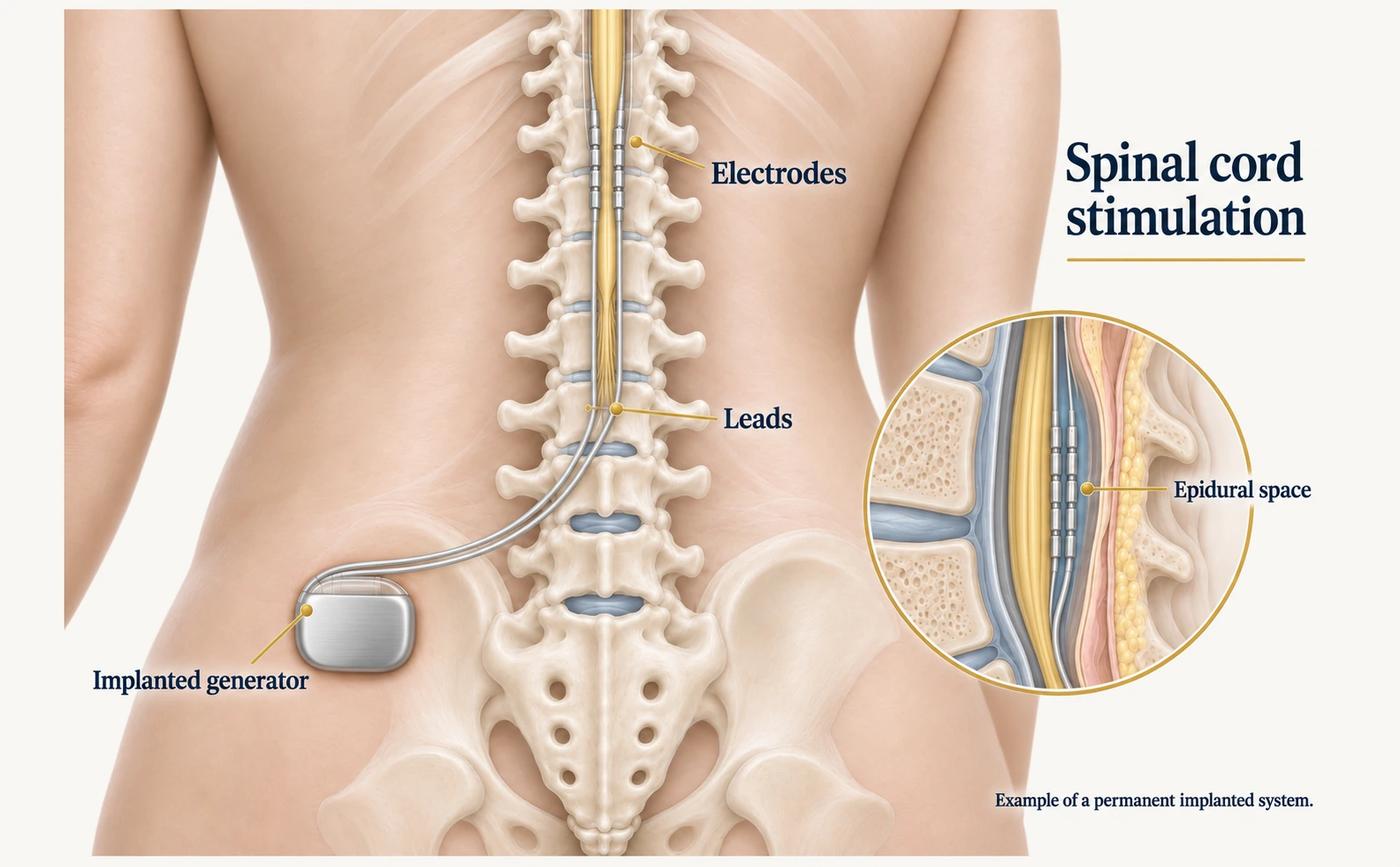
Electrical leads are placed in the epidural space near the spinal cord and connected to a pulse generator. Stimulation changes activity in pain-processing pathways. Some programs produce tingling; others are designed to work without it. Tonic, high-frequency, burst, and other approaches differ in programming and supporting studies. [2,7]
SCS does not decompress nerves, remove scar tissue, rebuild discs, or correct instability. A branded system capable of several waveforms is not proof that every waveform has equal evidence for every condition. Treatment requires ongoing programming and patient involvement.
Who may benefit?
Candidates generally have substantial pain-related limitation despite a reasonable treatment course, an appropriate diagnosis, realistic goals, and the ability to manage an implant. Assessment reviews imaging, prior surgery, medication, infection and bleeding risks, sleep, mood, substance use, and practical support. Psychological assessment is intended to identify barriers and improve preparation, not to imply that pain is imaginary. [7]
A temporary trial usually precedes permanent implantation. The patient tracks pain and meaningful activities, such as walking or sleeping, while using an external generator. A commonly used pain threshold is at least 50% improvement, but function, medication use, and the quality of the trial also matter. A successful trial cannot guarantee years of benefit.
What happens during treatment?
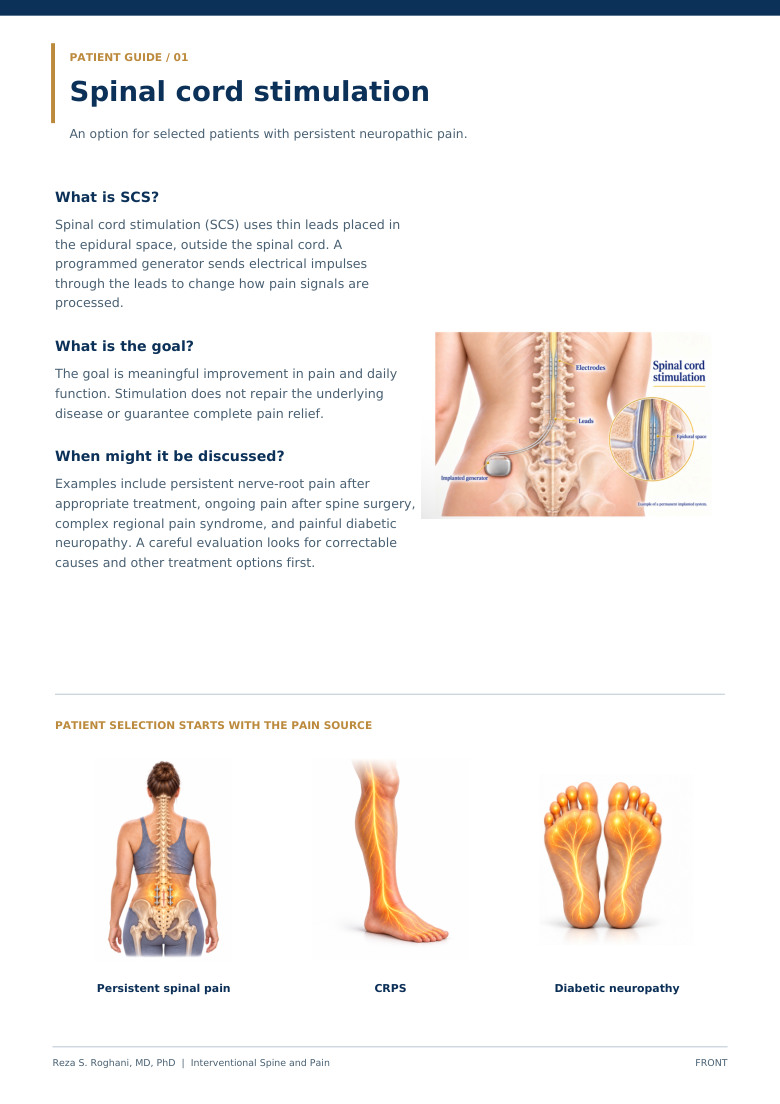
Trial leads are commonly placed through needles under fluoroscopy with local anesthesia and sedation tailored to safe communication and the procedure. Leads exit through a dressing and connect to an external controller. Trial duration, medication instructions, and activity precautions follow the treating team’s plan. [7]
If the trial is useful and the patient elects implantation, permanent leads are connected to a generator beneath the skin. Some patients need surgically placed paddle leads rather than percutaneous leads. Rechargeable and nonrechargeable generators impose different maintenance needs. Programming, wound checks, and education continue after implantation.
Spinal cord stimulation on fluoroscopy


What does the research show?
PROCESS randomized 100 patients with predominantly neuropathic leg pain after back surgery to SCS plus medical management or medical management alone. At six months, at least 50% leg-pain relief occurred in 48% versus 9% in the intention-to-treat analysis. The study was unblinded and involved manufacturer support; it supports selection for a particular postsurgical pain pattern rather than all back pain. [1]
SENZA randomized 198 people with chronic back and leg pain to 10-kHz or traditional low-frequency SCS. The trial and its two-year follow-up favored high-frequency treatment on responder outcomes. However, this was an active-device comparison rather than a sham-controlled test, and implantation followed screening trials. It does not establish superiority of all high-frequency systems or prove benefit over no stimulation in every patient. [2,3]
DISTINCT randomized 269 patients with refractory back pain who had not undergone lumbar surgery and were not candidates for corrective surgery. Burst SCS produced greater improvement than conventional medical management at six months. The study expands the evidence for a specific nonsurgical population but was unblinded and manufacturer-sponsored. The comparison, selection criteria, and handling of trial failures matter when interpreting responder percentages. [4]
A contrasting study by Hara and colleagues randomized 50 postsurgical patients in a crossover comparison of burst stimulation and placebo stimulation. Disability improved during both periods, without a significant advantage for active stimulation. This shows that benefit compared with usual care and benefit beyond placebo are different questions. [5]
The 2023 Cochrane review found no convincing medium-term advantage over placebo for low back pain in the available sham-controlled evidence and highlighted uncertainty and adverse events. It does not mean that every diagnosis or newer system has been tested equally. Taken together, favorable open-label trials and less favorable sham comparisons justify a careful, diagnosis-specific discussion rather than a blanket promise. [6]
The 2026 DISTINCT two-year publication adds durability information. After crossover and attrition, later treatment results are less useful for estimating a persistent randomized difference. They should not be counted as an independent trial or as evidence for every waveform. [9]
Benefits, limitations, and risks
Useful outcomes include less pain interference, improved sleep and walking, and better participation in rehabilitation. Relief may decline over time. Reprogramming, treatment of another pain source, lead revision, generator replacement, or removal may be necessary. Opioid reduction is a possible outcome, not an automatic consequence.
Risks include infection, bleeding around the spinal canal, dural puncture headache, lead movement or fracture, generator discomfort, unintended stimulation, and rare serious neurologic injury. A device-specific complication rate from one older trial should not be presented as the rate for every modern system. MRI access depends on the complete implanted system and scanning conditions. [1,5,7]
Recovery, alternatives, and sequencing
Early recovery protects the wound and leads. Bending, twisting, lifting, bathing, driving, and work restrictions depend on the implant and clinician. Follow-up checks healing and programming before activity is advanced. Fever, wound drainage, severe new spinal pain, weakness, or bowel or bladder changes need prompt assessment.
Alternatives include continued rehabilitation, medication optimization, targeted procedures for confirmed pain sources, peripheral stimulation, and surgery when a correctable lesion exists. SCS should fit a broader care plan. Discuss battery maintenance, future procedures, costs, MRI requirements, and an exit plan before implantation. A representative manufacturer guide can explain equipment but should supplement independent research.
Questions to ask your physician
- Which diagnosis and waveform have evidence closest to my situation?
- What should I record during the trial?
- How do sham-controlled findings affect expected benefit?
- What are the chances of revision, replacement, or removal?
- What activity and MRI restrictions apply to this system?
References
- Kumar K, et al. Spinal cord stimulation versus conventional medical management for neuropathic pain after back surgery: a multicentre randomized controlled trial. Pain. 2007;132:179–188. PubMed.
- Kapural L, et al. Novel 10-kHz high-frequency therapy versus traditional low-frequency SCS: the SENZA-RCT. Anesthesiology. 2015;123:851–860. PubMed.
- Comparison of 10-kHz high-frequency and traditional low-frequency SCS: 24-month results from a multicenter randomized controlled pivotal trial. Neurosurgery. 2016. Study DOI.
- Deer TR, et al. Treatment of refractory low back pain using passive recharge burst: findings from the DISTINCT randomized multicenter trial. Neuromodulation. 2023. DOI.
- Hara S, et al. Effect of spinal cord burst stimulation versus placebo on disability after lumbar spine surgery: a randomized clinical trial. JAMA. 2022. PubMed.
- Traeger AC, et al. Spinal cord stimulation for low back pain. Cochrane Database of Systematic Reviews. 2023;CD014789. DOI.
- Shanthanna H, et al. Evidence-based consensus guidelines on patient selection and trial stimulation for SCS in chronic non-cancer pain. Regional Anesthesia and Pain Medicine. 2023. DOI.
- Petersen EA, et al. Effect of high-frequency 10-kHz SCS in painful diabetic neuropathy: a randomized clinical trial. JAMA Neurology. 2021. DOI.
- Passive recharge burst SCS for refractory nonsurgical low back pain: 24-month results from a prospective randomized controlled trial and predictors of success. North American Spine Society Journal. 2026;27:100911. PubMed.