

Evidence reviewed through October 26, 2026.
What does it treat?
Peripheral nerve stimulation, or PNS, targets selected nerves outside the spinal cord. It may be considered for persistent pain after injury or surgery, certain painful limb conditions, and selected chronic back pain. The nerve target and system should match the diagnosis. Evidence for postamputation pain, for example, does not establish effectiveness for every painful knee, foot, or peripheral neuropathy. [1,2,7]
Assessment begins with the pain distribution, sensory and motor examination, and the effect on daily activities. Ultrasound, MRI, or electrodiagnostic testing may help identify nerve injury, entrapment, or another cause. An abnormal nerve test is not automatically an indication for stimulation, and a normal test does not exclude every neuropathic pain condition.
How does it work?
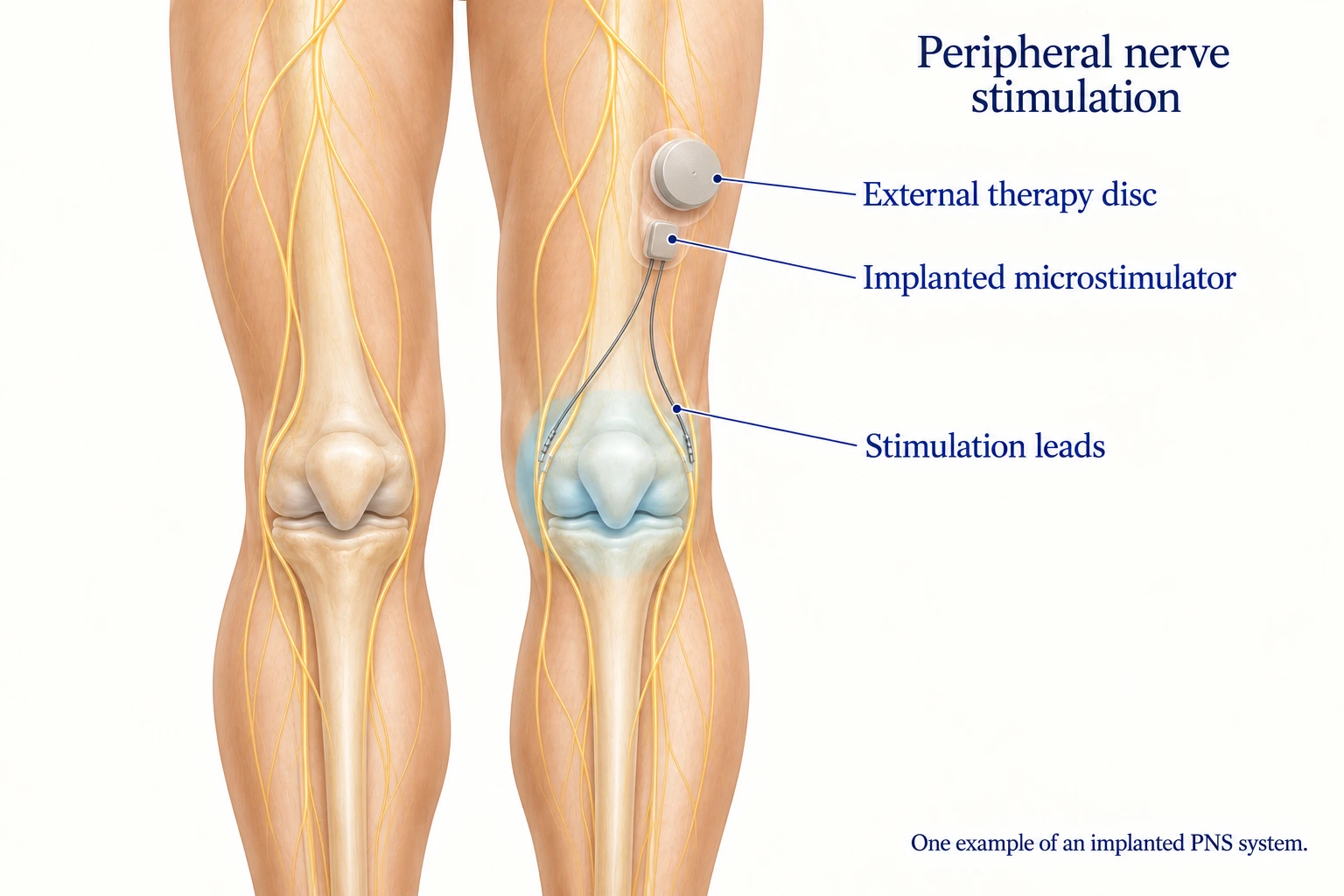
A thin lead delivers electrical stimulation near a selected nerve. The aim is to influence pain signaling and, with some targets, muscle activation and sensorimotor function. Stimulation does not physically release an entrapped nerve, repair a tendon, replace a damaged joint, or reliably restore lost nerve fibers. [7,8]
Temporary percutaneous systems are used for a prescribed period and then removed. Longer-term systems leave leads and sometimes a small implanted generator in place, often with wearable external components. These differ from surface TENS, spinal cord stimulation, and implantable restorative multifidus stimulation. Their results should be discussed separately.
Who may benefit?
Candidates generally have an identifiable target, persistent functional limitation, and an inadequate response to reasonable nonsurgical treatment. The team evaluates previous surgery, nerve function, infection and bleeding risks, expectations, and whether the patient can manage dressings, controls, and follow-up. A diagnostic nerve block may help in some settings, but its response is not a universal or perfectly reliable predictor of PNS benefit. [7,8]
Correctable nerve compression, an unstable or infected joint replacement, vascular disease, or progressive neurologic loss may require treatment of the underlying problem first. For chronic back pain, selection for temporary medial branch PNS differs from selection for cutting the medial branches or implanting a restorative system.
What happens during treatment?
PNS is usually placed as an outpatient procedure. The clinician reviews imaging, medications, skin condition, and anesthesia needs. Under local anesthesia, often with limited sedation when needed, ultrasound or fluoroscopy guides a lead near the target. Test stimulation checks coverage, comfort, and unwanted muscle or sensory effects. [1,2,7]
A temporary lead exits the skin and connects to an external unit. A permanent system may require a trial, implanted generator, or wearable power component, depending on the device. The patient receives instructions for wound care, bathing, activity, and equipment. Removal of a temporary lead and management of a permanent implant are planned differently.
What does the research show?
A placebo-controlled postamputation trial enrolled 28 patients; 26 were included in the primary efficacy analysis. During weeks one through four, at least 50% pain reduction occurred in 7 of 12 patients receiving PNS, or 58%, versus 2 of 14 receiving placebo, or 14%. The small sample and specific femoral/sciatic nerve targets limit generalization. Twelve-month follow-up suggested lasting relief in some patients after lead removal, but crossover and small numbers weaken long-term controlled conclusions. [1,3]
A randomized sham-controlled trial of 60-day PNS after knee replacement randomized 56 patients and reported its primary endpoint in 41 participants: 12 of 20 treated patients, or 60%, versus 5 of 21 sham patients, or 24%, achieved at least 50% pain reduction during weeks five through eight. The result concerns persistent postoperative pain and those nerve targets, not untreated knee arthritis in general. [2]
COMFORT compared a micro-implantable PNS system plus medical management with medical management alone. Its three- and six-month report favored stimulation; the twelve-month extension suggested continued benefit. The study was not sham-controlled and included several peripheral pain locations. Trial response and implantation selection affect how results should be explained to a patient starting evaluation. [4,5]
RESET randomized 222 patients with chronic low back pain to temporary 60-day medial branch PNS or usual interventional management. It reported a greater proportion achieving at least 50% pain reduction at three months with PNS. This is evidence for a particular temporary back-pain strategy; it does not establish the same outcome for permanent limb implants or all nerve conditions. [6]
Professional guidelines support indication-specific selection rather than treating PNS as one uniform therapy. Several key studies involved device manufacturers, investigator financial relationships, or company-employed authors. Funding does not invalidate findings, but device-specific results, unblinded comparisons, and independent confirmation should inform decisions. [1,2,4,7,8]
Benefits, limitations, and risks
Benefit may include less pain interference, improved walking or limb use, better sleep, and participation in rehabilitation. Some patients obtain no useful relief; others improve only while stimulation is active. Lasting benefit after temporary treatment is possible but should not be promised.
Risks include skin irritation, dressing reactions, bleeding, infection, painful stimulation, lead movement, lead fracture or retained fragments, nerve injury, and inadequate coverage. Implanted systems can require revision or removal. MRI restrictions differ, particularly if a fragment remains. Manufacturer instructions and the exact implanted components must be checked rather than assumed. [7,8]
Recovery, alternatives, and sequencing
Recovery includes protecting the lead or implant and monitoring skin and wound changes. Patients should follow device-specific bathing and activity instructions and contact the team about redness, drainage, fever, new weakness, or worsening pain. Follow-up should measure a practical goal such as stair climbing, prosthesis use, or time spent standing.
Alternatives include rehabilitation, appropriate medication, selected injections, correction of entrapment or joint pathology, and other neuromodulation approaches. Device clearance does not prove that every proposed indication is effective. The discussion should include total treatment duration, removal or replacement, ongoing costs, and what happens if benefit fades.
Questions to ask your physician
- Which nerve and diagnosis are being treated?
- Is the proposed system temporary or permanent?
- Which study best matches my condition and device?
- What wound care, activity limits, and MRI restrictions apply?
- How will we assess benefit and manage an unsuccessful treatment?
References
- Gilmore C, et al. Percutaneous peripheral nerve stimulation for chronic neuropathic postamputation pain: a multicenter randomized placebo-controlled trial. Regional Anesthesia and Pain Medicine. 2019. PubMed.
- Goree JH, et al. Randomized placebo-controlled trial of 60-day percutaneous peripheral nerve stimulation for persistent postoperative pain after knee replacement. Neuromodulation. 2024;27:847–861. DOI.
- Gilmore C, et al. Percutaneous 60-day peripheral nerve stimulation implant provides sustained relief following amputation: 12-month follow-up of a randomized placebo-controlled trial. Regional Anesthesia and Pain Medicine. 2020;45:44–51. DOI.
- Clinical study of a micro-implantable pulse generator for peripheral neuropathic pain: 3-month and 6-month COMFORT randomized trial results. Regional Anesthesia and Pain Medicine. 2025;50:561. DOI.
- Clinical study of a micro-implantable pulse generator for peripheral neuropathic pain: 12-month COMFORT randomized trial results. Regional Anesthesia and Pain Medicine. Online 2024;print 2026. DOI.
- Comparison of percutaneous 60-day PNS of the lumbar medial branches with usual care: the RESET randomized controlled trial. Pain Medicine. 2026;27:462–473. DOI.
- Strand N, et al. Evidence-based clinical guidelines from ASPN for implantable peripheral nerve stimulation in chronic pain. Journal of Pain Research. 2022;15:2483–2504. DOI.
- Consensus Guidelines from ASPN for the Use of 60-Day Peripheral Nerve Stimulation Therapy: A NEURON Living Guideline Project. Journal of Pain Research. 2025. DOI.