

Evidence reviewed through October 26, 2026.
What does it treat?
Restorative neurostimulation is intended for selected chronic mechanical low back pain associated with impaired control of the lumbar multifidus muscles. These deep muscles help control motion between individual vertebrae. After pain or injury, their activation may be inhibited; deconditioning, altered movement, and fatty change can accompany persistent symptoms. This is a proposed treatment target, not an explanation for every case of back pain. [1,7]
An MRI showing multifidus atrophy does not prove that the muscle is the principal pain source. Examination, movement assessment, symptom history, and imaging are considered together. Pain caused mainly by nerve compression, fracture, infection, or a condition requiring corrective surgery needs a different approach.
How does it work?
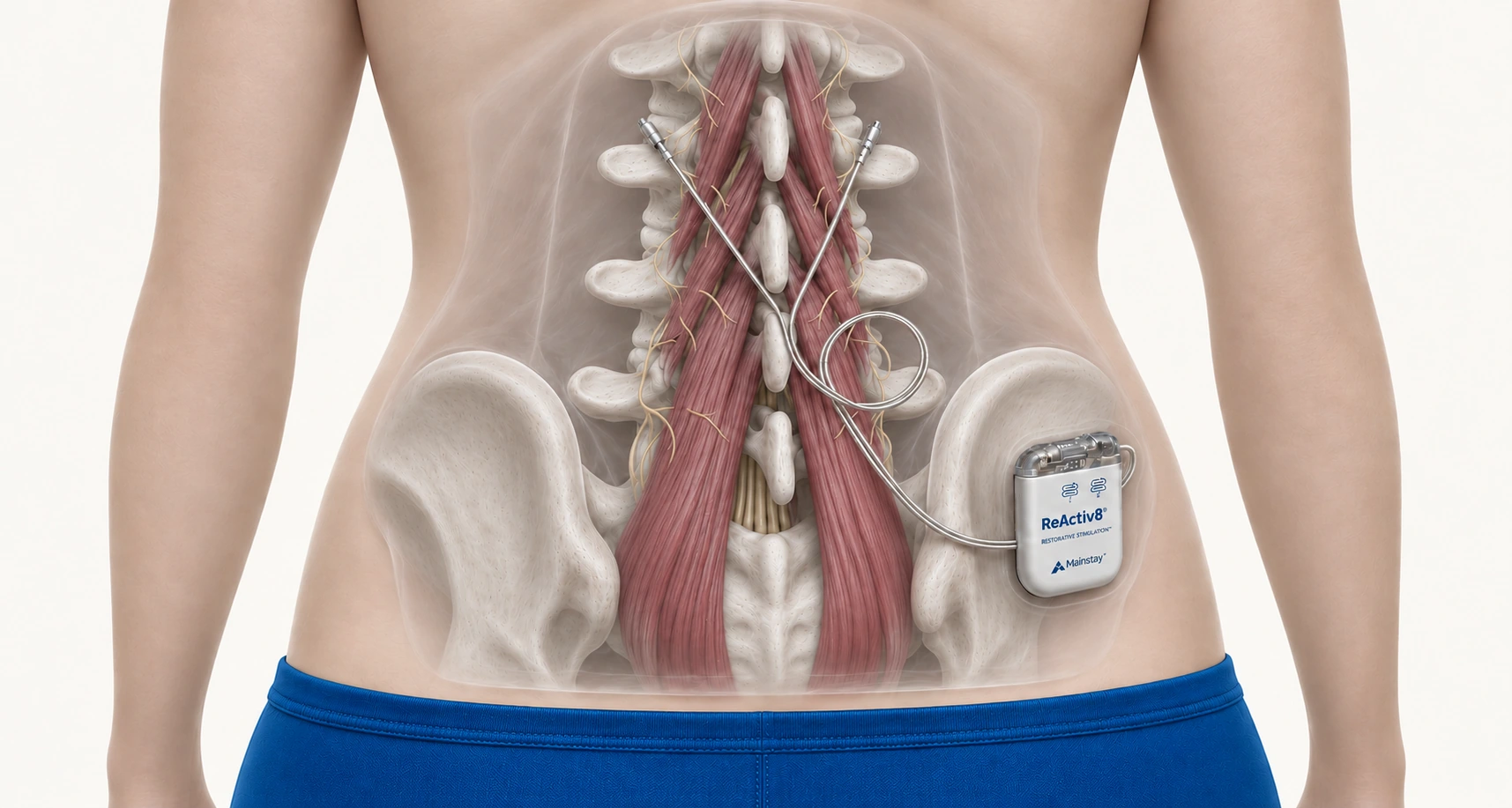
Implanted leads stimulate branches of the lumbar dorsal rami that supply the multifidus. The stimulation produces repeated muscle contractions during prescribed treatment sessions. The intent is rehabilitation of muscle activation and spinal control over time. It differs from spinal cord stimulation, which primarily aims to modify pain processing, and from rhizotomy, which interrupts nerve signaling. [1,7]
This approach does not fuse vertebrae, remove arthritis, or decompress nerves. Improved muscle recruitment is the proposed mechanism; it should not be described as proven regrowth of normal muscle or reversal of all structural degeneration.
Who may benefit?
The pivotal studies selected people with substantial, persistent mechanical back pain despite nonsurgical treatment, evidence suggesting multifidus dysfunction, and no indication for corrective spine surgery. A positive prone instability test was used in the pivotal trial, but no single examination or scan should replace a full assessment. [1,7]
The clinician considers pain with activity, motor control, rehabilitation history, bone and joint disease, psychological readiness, and the ability to use the device consistently. Patients need realistic goals and willingness to participate in a treatment course that may take months. A brief stimulation session cannot establish the long-term response.
Previous lumbar surgery deserves particular attention. The pivotal sham-controlled trial excluded important categories of previous surgery. Emerging experience in postsurgical patients should be considered separately rather than assuming that results apply equally after fusion, instrumentation, or medial branch injury.
What happens during treatment?
The procedure is generally performed in a surgery center or hospital with anesthesia suited to implantation. After reviewing medications, infection risk, and imaging, the clinician positions leads using fluoroscopy near the intended nerves and connects them to a generator beneath the skin. Stimulation testing helps assess the muscle response. [1,7]
Following wound healing and programming, patients perform prescribed sessions at home. The schedule is device-specific; the pivotal trial used thirty-minute sessions twice daily. Programming, comfortable contraction, adherence, and rehabilitation are reviewed over time. Unlike the usual SCS pathway, this rehabilitative treatment is not judged through the same short temporary analgesic trial.
What does the research show?
ReActiv8-B implanted and randomized 204 patients to therapeutic stimulation or low-level sham stimulation. At 120 days, 57.1% versus 46.6% reached the primary pain-response endpoint. The 10.4-percentage-point difference was not statistically significant. The original primary endpoint therefore did not establish superiority over sham, even though secondary outcomes and subsequent follow-up were favorable. [1]
After that comparison, sham participants crossed to therapeutic stimulation. Two- and three-year reports describe continuing improvement in pain and disability. Because everyone could receive active treatment, these later reports are observational extensions, not continuing sham-controlled evidence. They also follow the same underlying cohort. [2,3]
At five years, data were available for 126 of the original 204 implanted participants. In those assessed, average pain decreased from 7.3 to 2.4 out of ten and 71.8% reported at least 50% pain reduction. Those are substantial observed improvements, but attrition, treatment continuation, and the absence of an untreated comparison group must be considered. [4]
RESTORE compared restorative neurostimulation with optimal medical management. Its analysis included 203 participants. At one year, average ODI disability improvement was 19.7 points with stimulation versus 2.9 with medical management. This supports a clinically meaningful difference in that selected population, but participants were not blinded to having an implant. The 2026 two-year report includes delayed-start crossover and longitudinal treatment results rather than a persistent untreated comparison. [5,6]
Earlier ReActiv8-A follow-up also suggests durability, but it was a small uncontrolled cohort. Major studies involved manufacturer Mainstay Medical funding or participation and investigator relationships. Independent replication remains valuable. Evidence for this particular system cannot automatically establish equivalent outcomes for other muscle-stimulation devices. [1,5,8]
Benefits, limitations, and risks
The aim is improved activity tolerance and disability over months, not immediate masking of pain. Useful measures include sitting and lifting tolerance, walking, sleep, confidence with movement, and reduced interference with daily life. Some patients do not improve despite appropriate use. An implant also creates maintenance, follow-up, and possible future replacement needs.
Risks include infection, bleeding, wound problems, generator discomfort, lead movement or damage, unintended nerve injury, uncomfortable stimulation, and inadequate benefit. Revision or removal may be necessary. MRI conditions depend on the exact device. Patients should not assume that an MRI-compatible system permits every scan without preparation. [1,7]
Recovery, alternatives, and sequencing
Early recovery focuses on healing and protecting leads. Bending, lifting, twisting, driving, and return to work follow the implanting team’s instructions. Programming and rehabilitation are then adjusted gradually. Response should be assessed at agreed intervals over months rather than judged from the first week.
Alternatives include targeted exercise, motor-control rehabilitation, medication when appropriate, and treatment of other supported pain sources. Facet RFA, BVNA, SCS, and decompression address different mechanisms and should not be treated as interchangeable steps. New weakness, bowel or bladder changes, fever, or worsening wound symptoms require prompt assessment.
Questions to ask your physician
- What supports multifidus dysfunction as a meaningful contributor to my pain?
- How does my surgical history compare with the study populations?
- How should I interpret the inconclusive sham-controlled primary result?
- What daily use and rehabilitation will be required?
- When will we reassess benefit, and what happens if it is inadequate?
References
- Gilligan C, et al. An implantable restorative-neurostimulator for refractory mechanical chronic low back pain: a randomized sham-controlled clinical trial. Pain. 2021;162:2486–2498. PubMed.
- Gilligan C, et al. Long-term outcomes of restorative neurostimulation: two-year results of the ReActiv8-B pivotal trial. Neuromodulation. 2023. PubMed.
- Gilligan C, et al. Three-year durability of restorative neurostimulation effectiveness in patients with chronic low back pain and multifidus muscle dysfunction. Neuromodulation. 2023. PubMed.
- Gilligan C, et al. Five-year longitudinal follow-up of restorative neurostimulation in refractory chronic low back pain associated with multifidus dysfunction. Neuromodulation. 2024. DOI.
- Schwab F, et al. Restorative Neurostimulation Therapy Compared to Optimal Medical Management: A Randomized Evaluation (RESTORE). Pain and Therapy. 2025;14:401–423. DOI.
- Restorative neurostimulation outcomes for mechanical chronic low back pain: delayed-start crossover and 2-year longitudinal analyses from RESTORE. Spine Journal. 2026;online publication July 16. PubMed.
- Restorative Neurostimulation: A Clinical Guide for Therapy Adoption. Journal of Pain Research. 2022. DOI.
- Durability of the therapeutic effect of restorative neurostimulation for refractory chronic low back pain. Neuromodulation. 2022. PubMed.