

Evidence reviewed through October 26, 2026.
What does it treat?
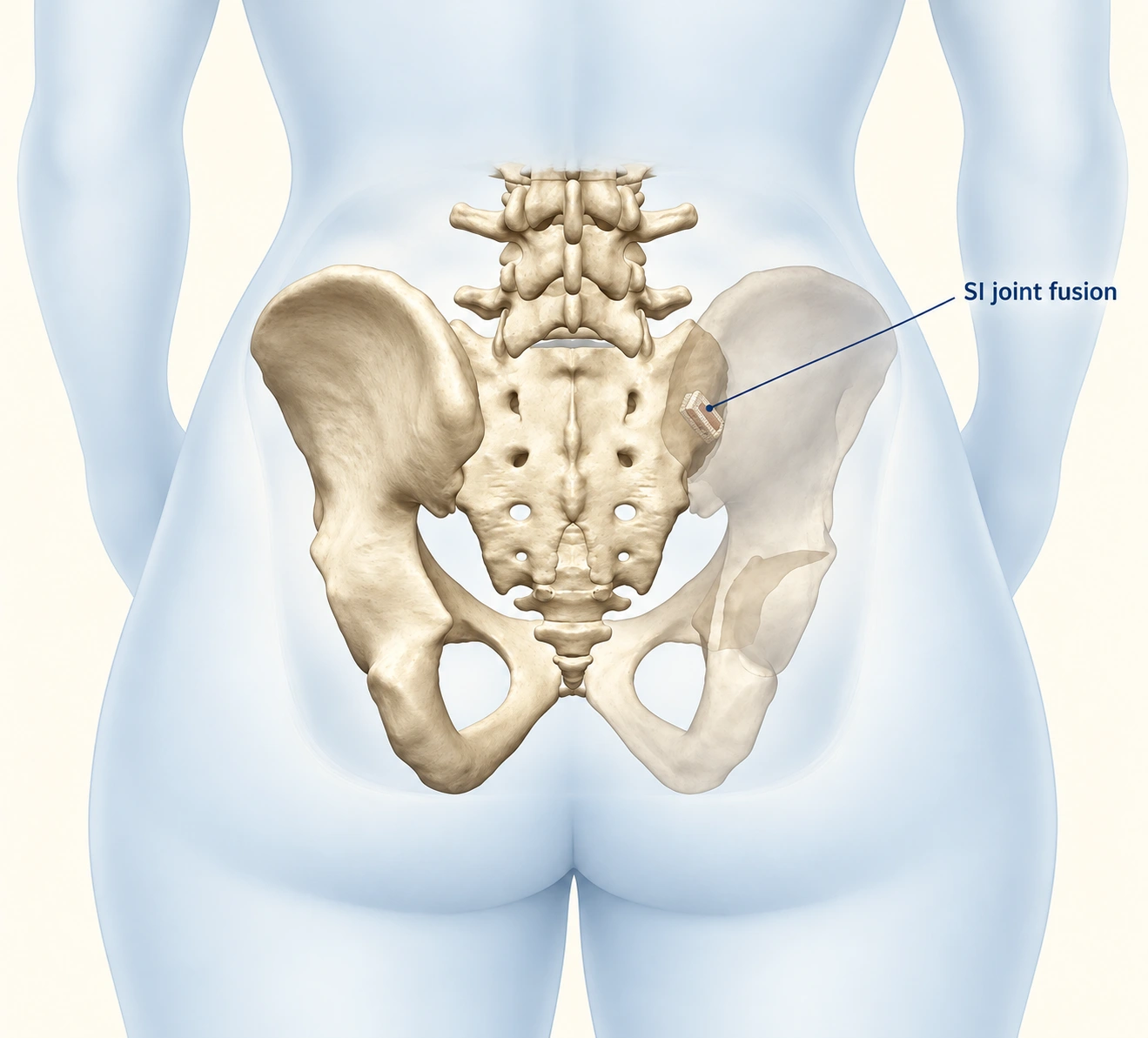
The sacroiliac, or SI, joints connect the sacrum to the pelvis. Pain may arise from the joint surfaces or surrounding ligaments and can be felt near the beltline, buttock, groin, or thigh. Symptoms may worsen with transfers, stairs, prolonged standing, or loading one leg. These patterns overlap with hip and lumbar conditions, so pain location alone does not establish the source. [1,2]
Fusion is intended for selected persistent SI joint pain. Arthritis or an irregular joint on imaging does not by itself justify surgery. Imaging is also used to look for fracture, inflammatory disease, infection, and other explanations. The painful structure must be identified as carefully as possible before an irreversible intervention.
How does fusion work?
Fusion aims to limit painful joint motion and encourage bone growth across the joint. Lateral transiliac approaches place implants across the joint through the ilium. Posterior approaches access the joint from behind and may use grafts, implants, or combinations. Their access paths, fixation, biological requirements, and evidence are not interchangeable. [3,4,5,6]
The operation does not treat all posterior pelvic pain. Pain from the surrounding ligaments, lumbar nerves, hips, or muscles may persist. Stabilizing a joint also does not guarantee a solid fusion or complete relief.
Who may benefit?
Evaluation includes the patient’s pain map, multiple examination maneuvers that stress the SI region, and assessment of the hips and lumbar spine. An image-guided local anesthetic injection can help determine whether the joint contributes to pain. A positive response supports the diagnosis but can be influenced by anesthetic spread and placebo effects. The number of injections and required relief threshold vary across guidance and coverage pathways. [1,2]
Candidates usually have substantial functional limitation despite appropriate rehabilitation and other nonsurgical care. Clinicians consider bone quality, smoking, infection risk, previous fusion surgery, expectations, and whether pain is mainly intra-articular or extra-articular. A reassuring MRI alone does not settle these questions.
Inflammatory sacroiliitis may need rheumatologic treatment. Fracture, active infection, major neurologic findings, or a different dominant pain generator require a different plan. Previous lumbar fusion can increase diagnostic suspicion but does not confirm SI joint pain.
What happens during treatment?
The team reviews imaging, diagnostic injections, medications, bleeding risk, and anesthesia needs. Treatment usually occurs in a surgery center or hospital. Anesthesia and positioning depend on the approach and patient. The clinician uses fluoroscopy or navigation to guide implant or graft placement through a small incision.
Lateral implants cross bone and the joint; posterior procedures use a different corridor. Patients should know the exact implant, whether it provides immediate fixation, and what published results apply to that device. After treatment, monitoring includes pain, wound condition, and neurologic function. Weight-bearing instructions may differ substantially between techniques. [3,4,5,6]
What does the research show?
INSITE randomized 148 treated patients to triangular titanium implant fusion or nonsurgical management. At six months, its composite success endpoint was reached by 81.4% with fusion versus 26.1% with nonsurgical management. The endpoint combined pain improvement with absence of specified serious device events or reoperation. The trial was unblinded and manufacturer-sponsored by SI-BONE, so expectations and treatment differences may influence results. [3]
The iMIA trial randomized 103 patients to lateral fusion or conservative management. At two years, average pain improvement was about 45 points versus 11 on a 100-point scale; disability improvement also favored surgery. This supports a clinically relevant difference in that selected population, but the trial was not sham-controlled and involved industry participation. [4]
A 2024 double-blind trial randomized 63 patients to lateral fusion or sham surgery. At six months, pain improved by 2.6 points with fusion and 1.7 with sham. The between-group difference was approximately one point and was not statistically significant; the confidence interval included no difference. This finding tempers claims that improvement after surgery necessarily reflects the implant’s effect. [5]
For posterior allograft fusion, SECURE was a prospective single-arm study of a specific system. It reported improvements, but without a randomized control group it cannot establish superiority over lateral fusion, injections, or rehabilitation. Its findings should not be used as proof for every posterior graft or implant. Manufacturer sponsorship and investigator relationships should be considered. [6]
Recent multispecialty guidance acknowledges the contrasting evidence and the importance of selection. Longer follow-up from lateral fusion studies adds information about durability, but crossover and participant loss weaken controlled comparisons. No single success percentage accurately describes all SI fusion approaches. [1,7,8]
Benefits, limitations, and risks
Meaningful benefit may mean easier transfers, walking, sleep, and participation in rehabilitation. Pain reduction can be partial. Persistent symptoms may reflect a competing diagnosis, inadequate stabilization, failure of bone fusion, implant problems, or pain outside the joint.
Risks include bleeding, infection, wound problems, implant malposition, nerve irritation or injury, fracture, persistent pain, and the need for revision. Bone healing may be affected by poor bone quality and smoking. Fusion is not simply reversed by removing an implant. Published rates from one system should not be assigned to another procedure. [1,3,5,6]
Recovery, alternatives, and sequencing
Recovery combines wound healing, progressive loading, and longer-term bone healing. Some patients need walking aids or restricted weight bearing. Driving, lifting, rehabilitation, and return to work should follow the surgeon’s instructions. Early pain relief does not prove that the joint has fused.
Alternatives include targeted exercise, pelvic stabilization strategies, medication when appropriate, selected joint injections, and lateral branch radiofrequency ablation for suitable posterior SI complex pain. These treatments address overlapping but different structures. Fusion is considered after the diagnosis and expected advantages justify its additional burden. New weakness, bowel or bladder changes, fever, or worsening wound drainage warrant prompt assessment.
Questions to ask your physician
- How confident are we that the SI joint is the main pain source?
- Which approach and implant are proposed, and what evidence supports them?
- How do the sham-controlled findings affect my decision?
- What weight-bearing restrictions and rehabilitation will I need?
- What is the plan for persistent pain or failure to fuse?
References
- Consensus practice guidelines on sacroiliac joint complex pain from a multispecialty, international working group. Regional Anesthesia and Pain Medicine. 2025. DOI.
- Buchanan P, et al. Successful diagnosis of sacroiliac joint dysfunction. Journal of Pain Research. 2021;14:3135–3143. DOI.
- Polly DW, et al. Randomized controlled trial of minimally invasive SI joint fusion using triangular titanium implants versus nonsurgical management: 12-month outcomes. Neurosurgery. 2015. PubMed.
- Dengler J, et al. Randomized trial of sacroiliac joint arthrodesis compared with conservative management. Journal of Bone and Joint Surgery American. 2019;101:400–411. DOI.
- Randers EM, et al. The effect of minimally invasive sacroiliac joint fusion compared to sham operation: a double-blind randomized placebo-controlled trial. EClinicalMedicine. 2024;68:102438. DOI.
- Calodney A, et al. Safety, efficacy, and durability of outcomes: results from SECURE, a single arm, multicenter, prospective study on a minimally invasive posterior sacroiliac fusion allograft implant. Journal of Pain Research. 2024. DOI.
- Polly DW, et al. Two-year outcomes from a randomized controlled trial of minimally invasive sacroiliac joint fusion versus nonsurgical management. International Journal of Spine Surgery. 2016;10:28. DOI.
- Patel V, et al. Prospective trial of sacroiliac joint fusion using 3D-printed triangular titanium implants. Medical Devices: Evidence and Research. 2020;13:173–182. DOI.