

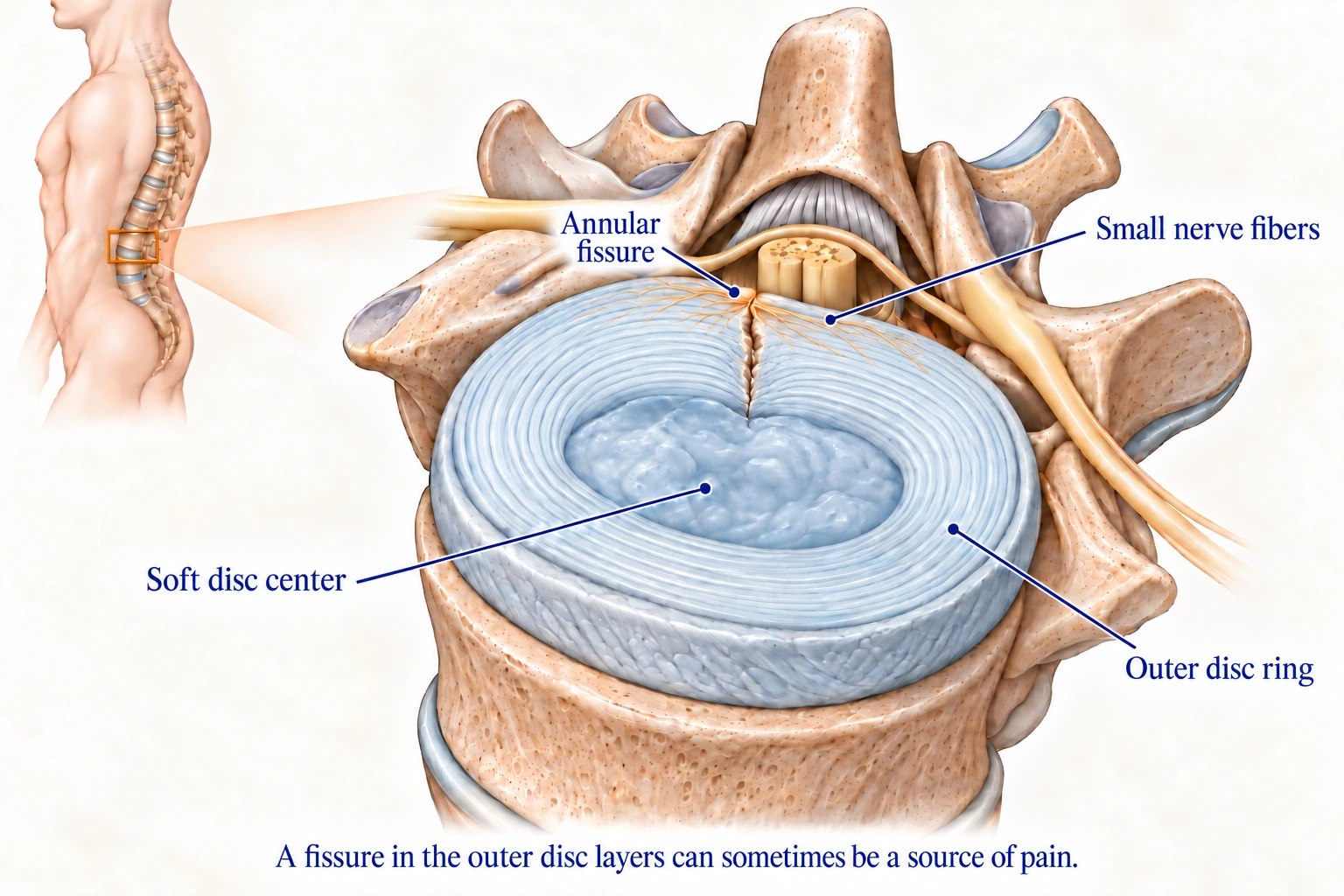
The outer ring of a lumbar disc can develop fissures. This illustration shows a possible pain mechanism; an annular fissure on MRI does not, by itself, establish that the disc is painful.
What does discogenic pain mean?
Intervertebral discs sit between the spinal bones. A soft center, the nucleus pulposus, is surrounded by a layered outer ring, the annulus fibrosus. Discs help distribute loads and allow movement. With age and other influences, they may lose water, change shape, or develop fissures. [1]
“Discogenic” means that the disc itself is believed to contribute to pain. In some discs, inflammation and changes involving the outer annulus and its sensory nerve supply may contribute. These mechanisms do not mean that every worn, narrowed, or fissured disc needs treatment. [2]
The phrase “degenerative disc disease” can sound alarming. It often describes structural changes rather than an actively worsening disease. Many people with these changes have no back pain, so an MRI report cannot establish the diagnosis on its own. [3]
What can it feel like?
Some patients describe a deep central low back ache, sometimes spreading into the buttocks or upper thighs. Sitting, bending, lifting, or prolonged positions may provoke symptoms. The same activities can aggravate other conditions, so this pattern is a clue rather than a diagnostic test. [1]
Disc pain, endplate pain, and nerve pain can overlap
| Possible source | What it refers to | Why the distinction matters |
|---|---|---|
| Discogenic pain | Pain attributed to the disc, including its outer annulus. | Disc changes must fit the overall assessment; no single MRI feature confirms the source. |
| Vertebrogenic pain | Pain associated with vertebral endplates, often with Modic type 1 or 2 MRI changes in appropriately selected patients. | Basivertebral nerve ablation targets endplate-related signaling, rather than repairing an annular fissure. |
| Radicular pain | Pain associated with a spinal nerve root, sometimes from a disc herniation. | Leg symptoms, weakness, and neurological findings may lead to a different treatment pathway. |
| Joint or muscle pain | Facet, sacroiliac, hip, or supporting muscle contributions. | A disc-directed procedure will not reliably address another pain generator. |
A herniated disc and a painful disc are related but different concepts. A herniation describes displaced disc material; whether it produces back pain, nerve symptoms, or no symptoms depends on the clinical situation. Disc and endplate changes can also coexist. [1] [4]
How is it evaluated?
Start with the history and examination
Assessment reviews the pain location, duration, triggers, prior treatment, neurological symptoms, and effect on activity. Examination also considers nearby joints, movement, strength, sensation, and reflexes. Sleep, work demands, and fear of movement may influence disability without identifying one anatomical source.
Use imaging when it can change care
Routine early imaging is generally unnecessary for uncomplicated low back pain. MRI becomes more useful when symptoms persist despite appropriate care, a procedure is being considered, or warning signs suggest a different problem. The timing and study depend on the clinical question. [5]
Disc dehydration, height loss, annular fissures, and a “high-intensity zone” can help describe a disc, but do not independently prove it causes pain. MRI also helps look for nerve compression, endplate changes, and alternative explanations. [2] [3]
Is discography necessary?
Provocative discography places a needle into a disc and assesses the response to controlled injection. Its use remains selective and debated. It is not a routine test for every patient with disc degeneration, and reproducing familiar pain does not guarantee benefit from surgery or an injection. [2]
Potential harms include infection, pain flare, and disc injury. A long-term matched-cohort study found greater degeneration in injected discs, which is one reason to ask whether the result would meaningfully change a treatment decision. [6]
Before choosing a disc-directed procedure
- What supports the disc as an important contributor?
- Have nerve, endplate, joint, and muscle sources been considered?
- Which daily activity should improve?
- What is the evidence for this exact preparation or procedure?
- What are the alternatives, risks, total costs, and next steps if it does not help?
How is care planned?
Build capacity before escalating treatment
Initial care usually emphasizes staying active within tolerance, progressive exercise, and a rehabilitation plan matched to symptoms and goals. Pacing, lifting strategies, and changing position can help patients rebuild activity. Prolonged bed rest is generally unhelpful. [1]
For chronic low back pain, exercise and approaches such as cognitive behavioral therapy or multidisciplinary rehabilitation are supported options. The aim is better function and confidence as well as less pain; improvement does not require the MRI to look normal. [7]
Medication may support activity when appropriate. NSAIDs are an option for some patients, but kidney, gastrointestinal, cardiovascular, and bleeding risks must be considered. Duloxetine may be considered in selected chronic low back pain cases after discussion of benefits and adverse effects. Long-term opioid therapy is generally avoided when safer approaches can meet the goals. [7]
Match a procedure to the suspected source
| Option | When it may be discussed | Important limits |
|---|---|---|
| Intradiscal PRP | Selected persistent suspected disc pain after a diagnostic assessment and an adequate course of nonsurgical care. | Trials have mixed results. Preparation methods differ, and reliable disc regrowth has not been established. |
| Nucleus pulposus tissue supplementation | Selected patients being evaluated for a disc tissue allograft, such as VIA Disc NP. | A different material from PRP. Early prospective studies do not establish superiority or a predictable durable benefit. |
| Other intradiscal procedures | Selected patients considering thermal or other disc-directed techniques. | Evidence, eligibility, and coverage differ by procedure. “Minimally invasive” does not establish effectiveness or eliminate risk. |
| Basivertebral nerve ablation | A matching vertebrogenic clinical pattern with appropriate endplate MRI findings and other candidacy criteria. | Not a general treatment for every degenerated disc or annular fissure. |
| Surgical consultation | Persistent disabling symptoms after appropriate care, with a carefully defined problem and suitable anatomy. | Fusion or disc replacement requires individualized selection. MRI degeneration alone is not an indication. |
What is an intradiscal injection?
A needle is placed into the disc under imaging guidance to deliver a specified preparation. PRP is prepared from the patient's blood; nucleus pulposus allograft uses processed donor tissue. They should not be treated as interchangeable therapies. Bone marrow concentrate is another distinct preparation. [8] [10] [13]
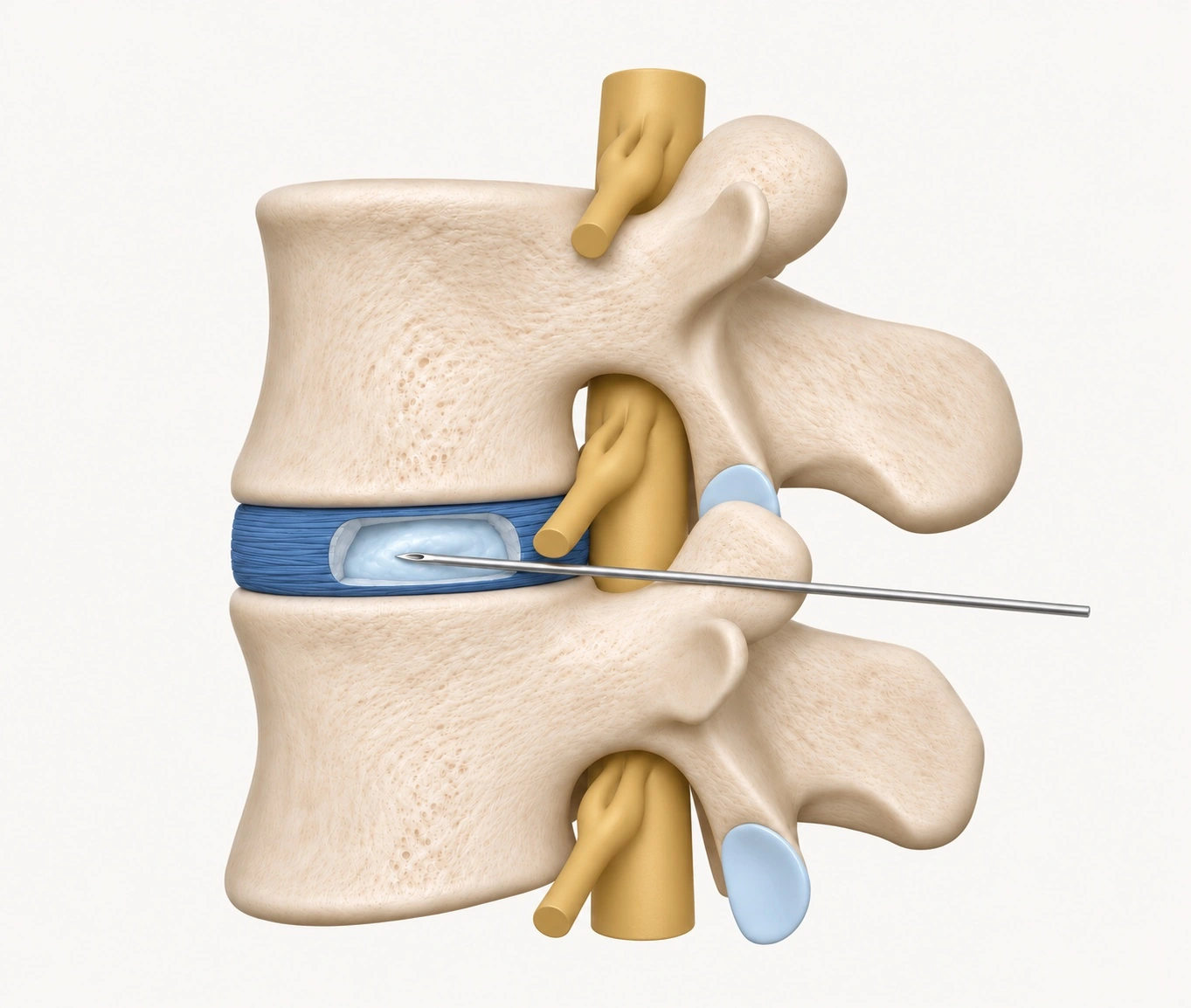
Risks include disc infection, bleeding, pain flare, and injury to nearby structures. Discuss medication management, infection precautions, recovery restrictions, and when to contact the treating team. An injection may not help even when the disc is believed to contribute. [9]
Availability is different from demonstrated effectiveness
Ask about the exact material, its regulatory status, and evidence for the proposed use. FDA registration, a trial listing, or availability for purchase is not equivalent to FDA approval demonstrating effectiveness for back pain. Claims that an injection will reliably regenerate a disc deserve careful scrutiny. [11]
When does surgery enter the discussion?
Fusion and artificial disc replacement may be considered in carefully selected patients, but neither guarantees relief. The surgeon evaluates the suspected pain source, instability, other spinal findings, general health, and prior rehabilitation. A randomized trial with long-term follow-up did not show a clear advantage of fusion over cognitive intervention and exercise for its selected chronic back pain population; crossover and the specific study population limit broad conclusions. [12]
Decompression or discectomy for a compressed nerve answers a different question from surgery for isolated back pain. New or progressive neurological deficits require timely assessment rather than simply continuing a disc-pain treatment pathway.
What does the evidence support?
PRP trials have not produced a consistent answer
A small 2016 randomized study reported improvements in selected outcomes over eight weeks. A later trial randomized 98 patients with suspected discogenic pain without Modic changes; at one year it found no significant advantage of PRP over its control injection. A serious disc infection occurred in the PRP group. Differences in selection, preparation, and study design matter. [8] [9]
Other biologic preparations need their own evidence
A 2025 double-blind sham-controlled trial of intradiscal bone marrow concentrate did not demonstrate a significant advantage over sham. A prospective study of nucleus pulposus allograft reported improvement, but lacked a randomized control group. Neither result can simply be transferred to a different preparation or patient group. [10] [13]
Guidelines differ, and certainty remains limited
NASS guidance found insufficient evidence to recommend for or against intradiscal PRP or bone marrow concentrate. ASIPP's 2025 update gives these treatments a moderate consensus recommendation while grading the evidence as Level III, fair. These are different assessments of a developing field, rather than proof of a universally superior treatment. [2] [14]
Judge treatment by meaningful outcomes. Ask about improvements in sitting, sleep, work, and activity, how long they lasted, and whether a comparison group improved too. A smaller pain score does not prove that the disc regenerated.
Common questions
Does an annular tear mean my disc is permanently damaged?
An annular fissure describes a structural finding. It may or may not contribute to pain, and it does not determine your future function. Treatment decisions depend on symptoms and the overall assessment.
Can a disc be painful without a herniation?
Yes. Pain attributed to the disc does not require displaced material pressing on a nerve. Conversely, a herniation can be present without causing symptoms.
Is discogenic pain the same as vertebrogenic pain?
No. Discogenic pain refers to the disc; vertebrogenic pain refers to vertebral endplate-related pain. The structures are closely connected and may both contribute. Their treatment targets differ.
Will PRP or a tissue injection regrow my disc?
Reliable restoration of a normal disc has not been established. Some patients improve symptomatically, but the evidence is mixed and improvement does not demonstrate structural regeneration.
Do epidural injections treat discogenic pain?
Epidural injections are commonly considered for selected nerve root symptoms. Their rationale differs from an intradiscal procedure. A disc abnormality alone does not establish that an epidural injection will help isolated back pain.
Should I stop bending or exercising?
Usually the aim is a gradual return to movement. Temporarily adjusting a painful task can help, while a clinician or therapist builds a tolerable exercise plan. Restrictions after a procedure or for a specific unstable condition may differ.
References and further reading
Society guidance, imaging research, and comparative clinical studies supporting this guide.
- American Academy of Physical Medicine and Rehabilitation. Lumbar Disk Disorders. Read the patient overview.
- North American Spine Society. Diagnosis and Treatment of Low Back Pain. Read the clinical guideline.
- Brinjikji W, et al. Systematic literature review of imaging features of spinal degeneration in asymptomatic populations. AJNR Am J Neuroradiol. 2015;36:811–816. Read the imaging study.
- American Society of Pain and Neuroscience. Best Practice Guidelines on the Diagnosis and Treatment of Vertebrogenic Pain with Basivertebral Nerve Ablation. 2022. Read the vertebrogenic guidance.
- American College of Radiology and Radiological Society of North America. Appropriateness Criteria: Low Back Pain. RadiologyInfo. Read about imaging selection.
- Carragee EJ, et al. 2009 ISSLS Prize Winner: Does discography cause accelerated progression of degeneration changes in the lumbar disc: a ten-year matched cohort study. Spine. 2009. Read the long-term discography study.
- Qaseem A, et al. Noninvasive Treatments for Acute, Subacute, and Chronic Low Back Pain: A Clinical Practice Guideline From the American College of Physicians. Ann Intern Med. 2017;166:514–530. Read the nonsurgical care guideline.
- Tuakli-Wosornu YA, et al. Lumbar intradiskal platelet-rich plasma injections: a prospective, double-blind, randomized controlled study. PM&R. 2016;8:1–10. Read the early PRP trial.
- Schepers MO, et al. Effectiveness of intradiscal platelet rich plasma for discogenic low back pain without Modic changes: a randomized controlled trial. Interv Pain Med. 2022;1:100011. Read the one-year PRP trial.
- Bone marrow concentrate intradiscal injection for chronic discogenic low back pain: a double-blind randomized sham-controlled trial. Interv Pain Med. 2025. doi:10.1016/j.inpm.2025.100611. Read the sham-controlled trial.
- U.S. Food and Drug Administration. Important Patient and Consumer Information About Regenerative Medicine Therapies. Read the FDA information.
- No difference in 9-year outcome in CLBP patients randomized to lumbar fusion versus cognitive intervention and exercises. Eur Spine J. 2012. Read the long-term surgical comparison.
- Beall DP, et al. Supplemental nucleus pulposus allograft in patients with lumbar discogenic pain: results of a prospective feasibility study. 2025. Read the allograft feasibility study.
- American Society of Interventional Pain Physicians. Comprehensive Evidence-Based Guidelines for Regenerative Therapies in the Management of Chronic Low Back Pain: 2025 Update. Read the updated biologics guidance.
Updated October 22, 2026. Educational information; diagnosis and treatment require an individual medical evaluation.