

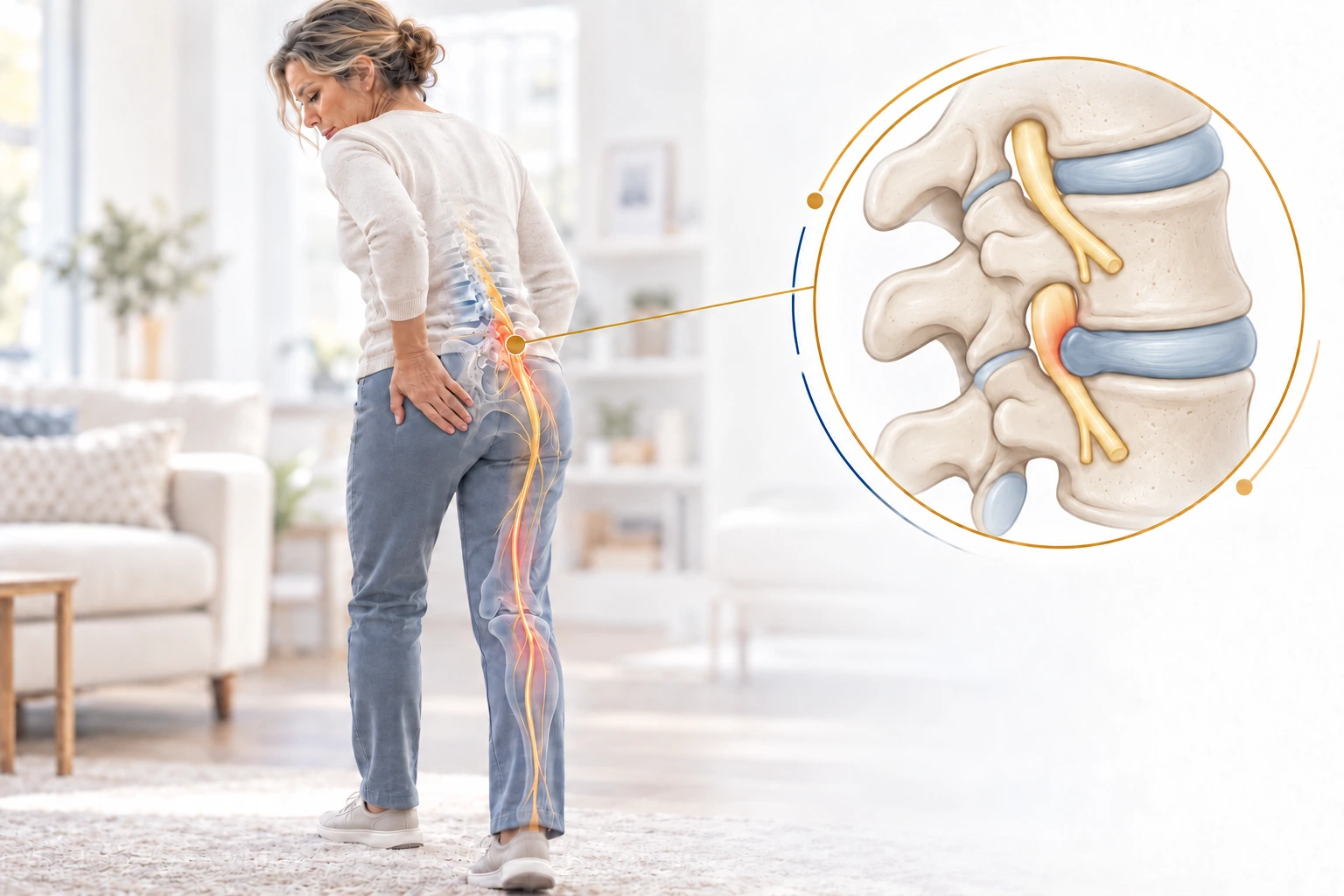
What it can feel like
Radicular pain comes from irritation of a spinal nerve root. It may feel sharp, shooting, burning, or electric as it travels into an arm or leg. Tingling or numbness may accompany it.
When the affected nerve is in the lower back, symptoms may extend into the buttock, leg, or foot. A nerve root in the neck can cause pain into the shoulder, arm, or hand.
Not every pain that spreads into a limb is radicular. Weakness, altered sensation, or reflex changes may indicate radiculopathy and need a neurological examination.
Follow the symptoms, then check the scan.
A disc bulge or narrowed opening matters when its location fits the pain pattern and examination. Not every pain spreading into an arm or leg comes from a spinal nerve root.
What is radicular pain?
Spinal nerve roots connect the spinal cord with nerves traveling into the body. When a root becomes irritated, pain may be felt along part of its distribution, well away from the spine. Pressure and inflammation can both contribute. In the lower back, this is often called sciatica, although that word is sometimes used more broadly for leg pain. [1]
Radicular pain and radiculopathy are related, but different
Radicular pain describes pain arising from an irritated nerve root. Radiculopathy describes impaired nerve root function, which may produce weakness, altered sensation, or reflex changes. Pain can occur without measurable loss of nerve function, and a person can have nerve dysfunction without severe pain.
This distinction matters because worsening weakness can change the urgency of treatment even when pain is improving. A neurological examination helps establish what needs monitoring. [2]
How symptoms differ by region
| Region | Possible symptoms | What needs attention |
|---|---|---|
| Neck: cervical | Pain into the shoulder, arm, or hand; tingling or numbness in part of the hand. | Changes in arm or hand strength. Balance problems or hand clumsiness can suggest spinal cord involvement. |
| Lower back: lumbar or sacral | Pain into the buttock, thigh, calf, or foot; burning, electric pain, or tingling. | Foot drop, difficulty lifting the toes, or reduced ability to push off while walking. |
| Mid-back: thoracic | Less commonly, a band of pain around the chest or abdomen. | New chest or abdominal pain requires assessment for nonspinal causes. |
Symptoms do not always trace the neat lines shown on anatomy charts. Your clinician looks for a consistent overall pattern rather than making a diagnosis from one painful spot or finger. [1] [2]
What causes nerve root irritation?
A herniated disc can irritate a nearby root. Degenerative changes may narrow the nerve's exit opening, called the foramen, or the spinal canal. A slipped vertebra can also reduce available space. Less common causes include infection, a mass, or other disease, which require a different approach. [3]
Spinal stenosis can cause symptoms with standing or walking, while disc-related symptoms may change with sitting, bending, coughing, or straining. These are clues rather than reliable stand-alone tests. Shoulder or hip disorders, peripheral nerve entrapment, and neuropathy can mimic or coexist with radicular symptoms.
How is it evaluated?
The examination comes first
Assessment starts with where the symptoms travel, how they began, and what changes them. Your clinician checks muscle strength, sensation, reflexes, and walking when relevant. Selected maneuvers, such as a straight-leg raise or a neck-positioning test, may reproduce familiar symptoms. Nearby joints and peripheral nerves are also examined. [2] [3]
When is MRI useful?
MRI can show a herniated disc or narrowing around a nerve. It is especially useful when a neurological deficit, persistent disabling symptoms, or planning for a procedure makes the result likely to change care. Red flags may require earlier imaging. A scan finding on the wrong side or at a level that does not fit the examination may be incidental. [3]
What do EMG and nerve conduction studies add?
These tests assess aspects of nerve and muscle function. They can help distinguish root-related dysfunction from conditions such as carpal tunnel syndrome, peroneal neuropathy, or a more generalized neuropathy. They complement the examination and MRI rather than replace them.
Can the EMG be normal even when the pain is nerve-related?
Yes. Needle EMG mainly detects changes involving motor nerve fibers and the muscles they supply. Testing may be normal with pain alone, predominantly sensory irritation, or early or mild disease. A normal test does not exclude all nerve root irritation; timing and the muscles sampled affect interpretation. [4]
Not everyone needs both MRI and EMG. The useful test is the one that answers a specific unresolved question and can change the treatment plan.
How is radicular pain treated?
Keep moving within a tolerable range
Many episodes improve without surgery. Care may include temporary adjustments to provoking activities, a gradual return to walking and daily tasks, and physical therapy tailored to the examination. Treatment should help you regain function without repeatedly aggravating limb symptoms. Prolonged bed rest is generally discouraged.
Track practical changes: sleep, walking distance, sitting tolerance, hand use, or ability to work. Report new weakness rather than measuring progress only by the pain score. [2] [5]
Choose medication carefully
Medication decisions depend on the diagnosis, other health conditions, and adverse effects. Anti-inflammatory medicines may be considered when appropriate, using the lowest effective dose for the shortest suitable time. Kidney, stomach, cardiovascular, and bleeding risks matter.
Evidence for a medicine in one neuropathic pain condition does not guarantee benefit for sciatica. NICE advises against routine gabapentinoids, oral corticosteroids, and benzodiazepines for sciatica, and against opioids for chronic sciatica. A placebo-controlled pregabalin trial found no significant benefit for leg pain and more adverse events. Discuss ongoing medicines with the prescriber; do not abruptly stop drugs that require tapering. [5] [6]
When might an epidural injection help?
An epidural steroid injection places anti-inflammatory medication in the epidural space near affected nerve roots. It may be considered when pain remains limiting despite appropriate initial care and the clinical and imaging findings support the target. Its purpose is to reduce symptoms and support activity or rehabilitation; it does not remove a disc fragment or enlarge a narrowed opening.
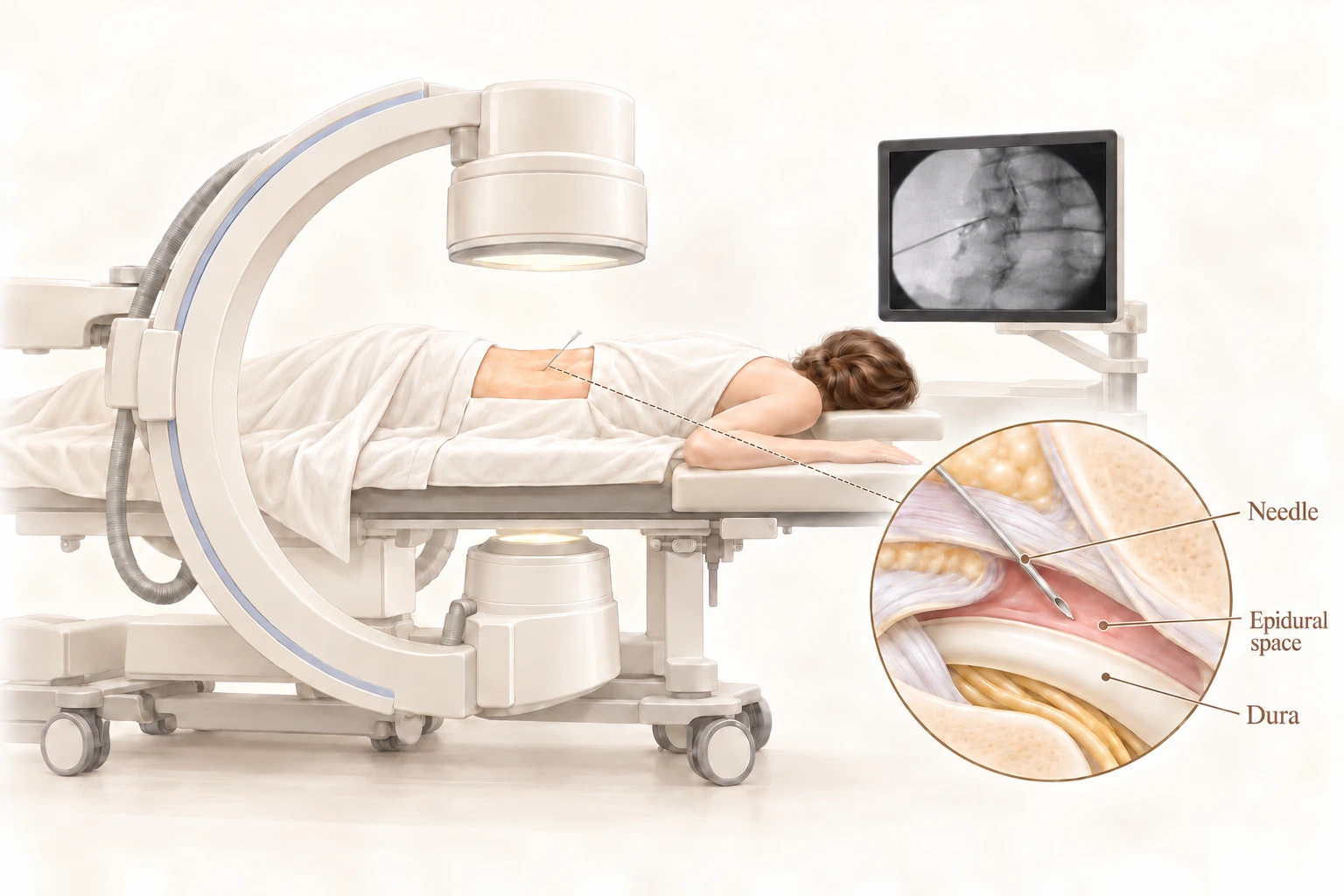
| Approach | General aim | Selection considerations |
|---|---|---|
| Transforaminal | Deliver medication near a selected nerve root through its exit region. | Target level, vascular anatomy, prior surgery, and steroid choice. |
| Interlaminar | Enter the epidural space between neighboring vertebral arches. | Available access space and intended medication spread. |
| Caudal | Enter through an opening at the lower sacrum for lumbar or sacral symptoms. | Distance to the target and expected medication spread. |
No approach is automatically best for every patient. A selective nerve root injection may also be used to help clarify a suspected symptomatic level, but anesthetic spread can limit its diagnostic precision. Repeat injections should be based on meaningful prior benefit, remaining goals, and risks rather than an automatic series. [14]
When is surgical evaluation appropriate?
Progressive motor weakness or signs of spinal cord or cauda equina involvement can require urgent surgical assessment. Persistent disabling symptoms with a matching structural cause may also justify consultation after appropriate nonsurgical care.
A discectomy removes selected herniated disc material; decompression creates more room for neural structures. Fusion is reserved for particular structural indications and is not required for every pinched nerve. The choice depends on anatomy, neurological findings, and goals. [3] [8]
Are facet rhizotomy or BVNA treatments for sciatica?
Medial branch rhizotomy and facet RFA target nerves supplying the facet joints. Basivertebral nerve ablation targets endplate-related vertebrogenic pain. These procedures address different sources; they do not decompress a spinal nerve root. If pain persists after surgery, reassess its cause before considering options such as neuromodulation.
What does the evidence show?
Epidural injections: mainly short-term benefit
A 2025 American Academy of Neurology review of 90 trials found that epidural steroid injections probably reduce short-term pain and disability in radiculopathy. About 24 more people per 100 had reduced pain and 16 more per 100 had reduced disability up to three months compared with control groups. These figures describe additional responders, not the percentage reduction in an individual's pain. Most evidence concerned lumbar disease; cervical evidence was much more limited. Long-term pain benefit remains uncertain. [9]
Recommendations differ. A 2025 BMJ guideline recommends against epidural injections for chronic radicular spine pain lasting at least three months. Different reviews weigh populations, comparisons, effect sizes, uncertainty, and treatment burden differently. A discussion should explain why an injection is being considered for your situation and what improvement would justify it. [10]
Surgery can offer faster relief in selected disc herniation
In a randomized trial of patients with severe sciatica lasting 6–12 weeks, early surgery produced faster relief than prolonged conservative treatment with surgery if needed. Outcomes were similar by one year. This does not apply to emergencies or mean all patients should wait: worsening neurological function changes the decision. The study compared treatment strategies, and some patients initially assigned to conservative care later underwent surgery. [11]
Benefits must be weighed against risks
Injection risks include soreness, bleeding, infection, dural puncture and headache, and temporary steroid effects such as increased blood glucose. Rare serious neurological injuries have been reported. The FDA warns of events including stroke and paralysis and notes that corticosteroids are not FDA-approved for epidural administration. Image guidance and technique-specific precautions reduce avoidable risk but cannot eliminate it. [7]
Tell the team about blood thinners, diabetes, infection, allergies, pregnancy, or prior spine surgery. Follow individualized medication and recovery instructions. Ask how expected benefit compares with continuing rehabilitation or obtaining a surgical opinion.
Questions patients often ask
Does a normal EMG mean my pain is not real?
No. A normal study means it did not detect the abnormalities assessed in the nerves and muscles tested. Pain-producing irritation can still be present. Your symptoms, examination, imaging, and test timing all matter. [4]
Does a large disc bulge always need surgery?
No. Disc size alone does not determine treatment. The affected side and level, neurological findings, symptoms, and progress are more useful for decision-making. [3]
If the injection helps, is the nerve healed?
Pain relief can make movement and rehabilitation easier, but it does not prove that compression has resolved or nerve function has recovered. Strength and sensation still need monitoring.
Why is my pain better but numbness still present?
Pain, sensation, and strength can recover at different rates. Persistent numbness deserves follow-up; new or worsening weakness requires prompt reassessment.
References and further reading
Professional society guidance, clinical trials, and safety information supporting this guide.
- American Academy of Physical Medicine and Rehabilitation. Lumbar Radiculopathy. Read the patient guide.
- American Academy of Orthopaedic Surgeons. Cervical Radiculopathy (Pinched Nerve). Read OrthoInfo guidance.
- American Association of Neurological Surgeons. Herniated Disc. Read the patient guide.
- Dillingham TR, Annaswamy TM, Plastaras CT. Evaluation of persons with suspected lumbosacral and cervical radiculopathy: electrodiagnostic assessment and implications for treatment and outcomes (Part I). Muscle Nerve. 2020;62:462–473. View on PubMed.
- National Institute for Health and Care Excellence. Low back pain and sciatica in over 16s: assessment and management (NG59). Read the recommendations.
- Mathieson S, et al. Trial of pregabalin for acute and chronic sciatica. N Engl J Med. 2017;376:1111–1120. Read the randomized trial.
- US Food and Drug Administration. Drug Safety Communication: rare but serious neurologic problems after epidural corticosteroid injections for pain. 2014. Read the FDA communication (PDF).
- American Academy of Orthopaedic Surgeons. Cervical Radiculopathy: Surgical Treatment Options. Read about surgical evaluation.
- Armon C, et al. Epidural steroids for cervical and lumbar radicular pain and spinal stenosis systematic review summary: report of the AAN Guidelines Subcommittee. Neurology. 2025;104:e213361. View on PubMed · Read the AAN summary.
- Commonly used interventional procedures for non-cancer chronic spine pain: a clinical practice guideline. BMJ. 2025;388:e079970. Read the guideline.
- Peul WC, et al. Surgery versus prolonged conservative treatment for sciatica. N Engl J Med. 2007;356:2245–2256. Read the randomized trial.
- American Association of Neurological Surgeons. Cauda Equina Syndrome. Read about emergency symptoms.
- American Academy of Orthopaedic Surgeons. Cervical Spinal Cord Compression. Read about myelopathy.
- Klessinger S, et al.; International Pain and Spine Intervention Society. Safety practices for interventional pain procedures: epidural and sacroiliac interventions. Interv Pain Med. 2025;4:100579. Read the safety practices.
Updated October 22, 2026. Educational information; treatment decisions require an individual medical evaluation.