

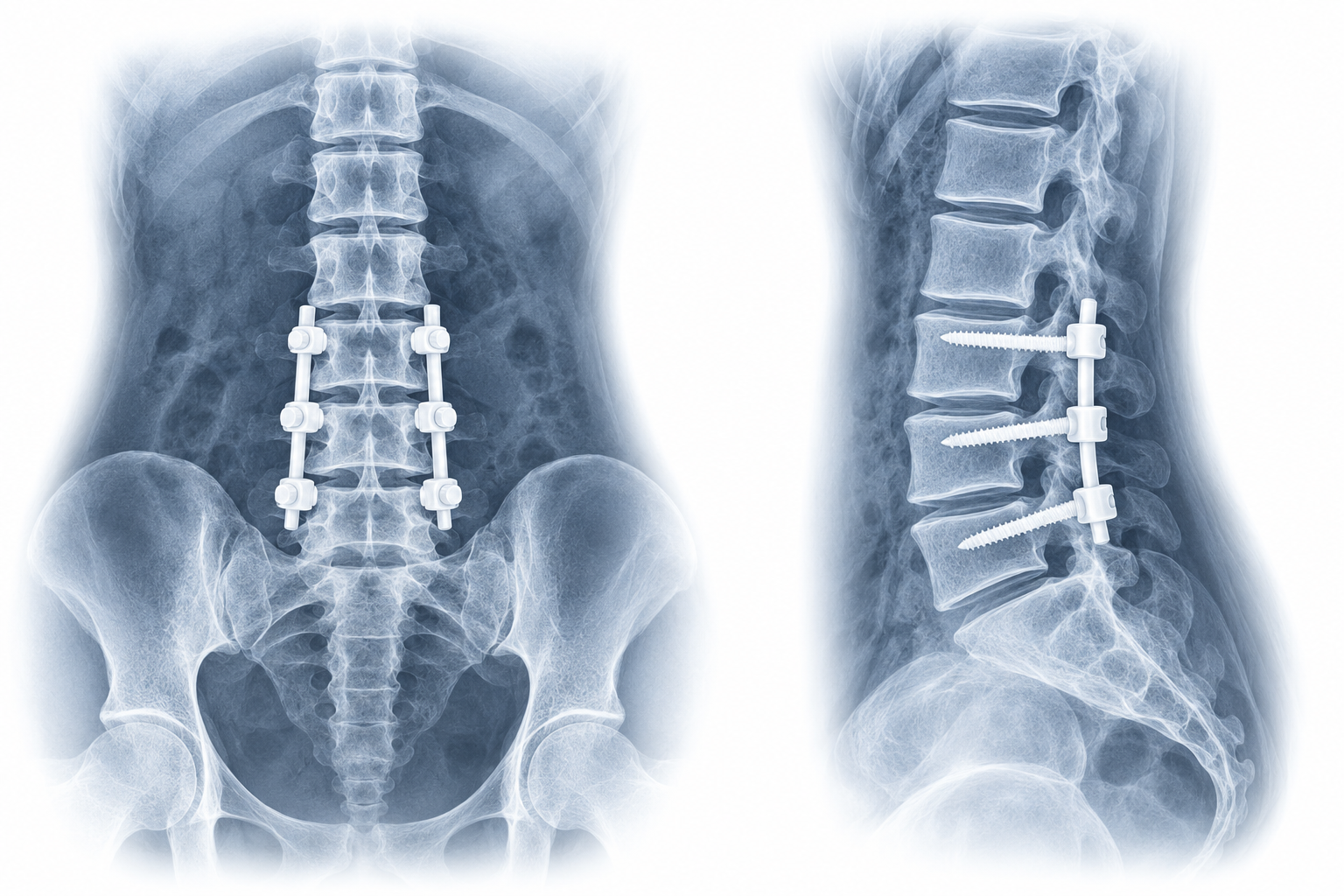
A lumbar fusion is one example of spine surgery. Persistent pain can also occur after decompression, discectomy, or other operations, and does not by itself establish a problem with the hardware.
The next step starts with finding what hurts now.
Pain after surgery may have a different source from the original pain. Review what improved, what remained, and what changed before choosing another procedure.
What does pain after spine surgery mean?
Some pain and stiffness are expected while tissues heal. The recovery course depends on the operation, the condition treated, and your health. Follow the surgical team's restrictions and contact them when recovery is moving in the wrong direction rather than assuming every symptom is normal. [1]
Persistent pain may continue from before surgery, recur after a period of relief, or arise in a new location. Clinicians increasingly use persistent spinal pain syndrome type 2 for chronic spinal pain in people who have had surgery. The older term “failed back surgery syndrome” is still found in records and research, but it does not explain the cause or mean that the patient or surgeon has failed. [2]
The term also does not prove that surgery caused all the pain. A technically successful operation can relieve one problem while another persists. Most evidence discussed below concerns pain after lumbar surgery; neck and other spinal operations require their own anatomical evaluation.
The timing helps guide the assessment
Tell your clinician whether the pain never improved, returned after meaningful relief, or is completely different. New severe pain or neurological symptoms soon after surgery need prompt contact with the surgical team. Later changes can reflect several causes and should not automatically be attributed to scar tissue. [1] [3]
Several contributors can overlap
| Possible contributor | What may prompt evaluation | How it is explored |
|---|---|---|
| Persistent nerve pain | Burning, electric pain, tingling, or numbness, sometimes despite adequate decompression. | Neurological examination, imaging review, and selected EMG testing. |
| Recurrent or residual compression | Returning limb pain, weakness, or symptoms with standing and walking. | Assess whether current radicular symptoms or stenosis match a treatable lesion. |
| Joint or nearby-level pain | Back or buttock pain that differs from the original nerve symptoms. | Evaluate facet joints, sacroiliac joints, hips, and adjacent spinal levels. |
| Muscle dysfunction | Reduced endurance, movement-related pain, or difficulty regaining activity. | Assess strength, conditioning, gait, and deep spinal muscle function. |
| Fusion, alignment, or implant concern | A suspected nonunion, instability, hardware problem, or deformity. | Surgical review and selected X-rays or CT; pain alone does not identify the cause. |
| Complication or other disease | Fever, wound drainage, sudden neurological change, or concerning systemic symptoms. | Urgent assessment for infection, bleeding, fracture, or another serious cause. |
Scar tissue may be visible around a nerve after surgery, but its presence on imaging does not prove it causes the pain. Similarly, degeneration at a nearby level may be incidental. The finding needs to fit the clinical picture. [3]
Sacroiliac joint pain is a recognized possibility after lumbar fusion. Studies using diagnostic injections have identified it in selected patients with persistent pain, but this does not mean everyone with a fusion has sacroiliac pain. [4]
Sleep disruption, stress, fear of movement, and increased nervous-system sensitivity can amplify symptoms and affect recovery. Addressing them is part of pain care and does not invalidate a physical problem. [2]
What should a fresh evaluation include?
Reconstruct the treatment history
Bring the operative report, implant information if available, earlier and recent scans, and a list of treatments and their effects. Explain which symptoms improved after surgery and for how long. This is often more useful than a long list of procedures without their outcomes.
Examination checks strength, sensation, reflexes, gait, the wound when relevant, nearby joints, and activities that reproduce familiar pain. The surgeon and rehabilitation or pain clinician may need to review the findings together. [3]
Choose imaging for a specific question
For new or worsening symptoms after lumbar surgery, MRI and radiographs may be appropriate. MRI with and without contrast can be useful for selected questions, including differentiating recurrent disc material from postoperative scar or assessing infection. Contrast is not required for every patient. CT may help evaluate bone, fusion, and hardware. The best study depends on the suspected problem and safety considerations. [5]
Use additional testing selectively
EMG and nerve conduction studies may distinguish nerve root dysfunction from peripheral nerve disease; a normal test does not exclude all pain-producing irritation. Blood tests may be needed if infection is suspected. Diagnostic joint or nerve blocks can test a focused hypothesis, but neither a positive block nor a scan guarantees treatment success. [6]
Questions worth answering before another procedure
- Which current symptoms are we trying to treat?
- What finding explains them, and how confident are we?
- Is there a problem that needs surgical correction?
- What daily activity should improve if treatment works?
- What will we do if the expected benefit does not occur?
How is care planned?
Rehabilitation and medication review
A rehabilitation plan should reflect the surgery, healing status, and current findings. It may address strength, endurance, balance, pacing, and a gradual return to meaningful tasks. Pain-focused psychological skills can help with fear of movement, sleep, and coping alongside physical treatment. A randomized trial found benefit from cognitive-behavioral-based physical therapy in selected patients after lumbar surgery; it is not a substitute for evaluating a new neurological or structural problem. [7]
Review medication benefits against dizziness, sedation, constipation, interactions, and other adverse effects. Neuropathic pain medicines may be considered when the diagnosis supports them, with a clear goal and review point. Follow the surgeon's advice about anti-inflammatory medicines during fusion healing. Do not abruptly stop prescribed opioids or medicines that require tapering. [1]
Targeted procedures require a matching source
| Option | When it may be discussed | What it cannot establish or correct |
|---|---|---|
| Epidural injection | Selected nerve-related symptoms with a suitable target and safe access. | Does not repair a nonunion, remove all scar, or correct major mechanical compression. |
| Facet RFA or rhizotomy | A supported facet pain diagnosis, with appropriate blocks and anatomy review. | Does not treat every source of postoperative back pain or decompress a nerve. |
| Sacroiliac treatment | Examination and selected testing support a sacroiliac contribution. | A fusion history alone is not a diagnosis or indication for another fusion. |
| Neuromodulation | Selected persistent pain after assessment of treatable causes and other care. | Does not correct instability, infection, implant failure, or urgent compression. |
| Revision surgery | A surgically addressable problem that fits symptoms and has a reasonable benefit-risk balance. | An abnormal scan alone does not guarantee that another operation will relieve pain. |
Previous instrumentation and altered anatomy can affect access and procedural planning. The appropriate sequence is individualized rather than an automatic progression from injection to implant to another operation. [8]
Spinal cord stimulation: evaluation, trial, then a decision
Spinal cord stimulation (SCS) uses electrical stimulation through leads placed in the epidural space to modify pain signaling. It may be considered for selected persistent neuropathic pain when appropriate treatment has not provided adequate relief and there is no untreated problem requiring another approach.
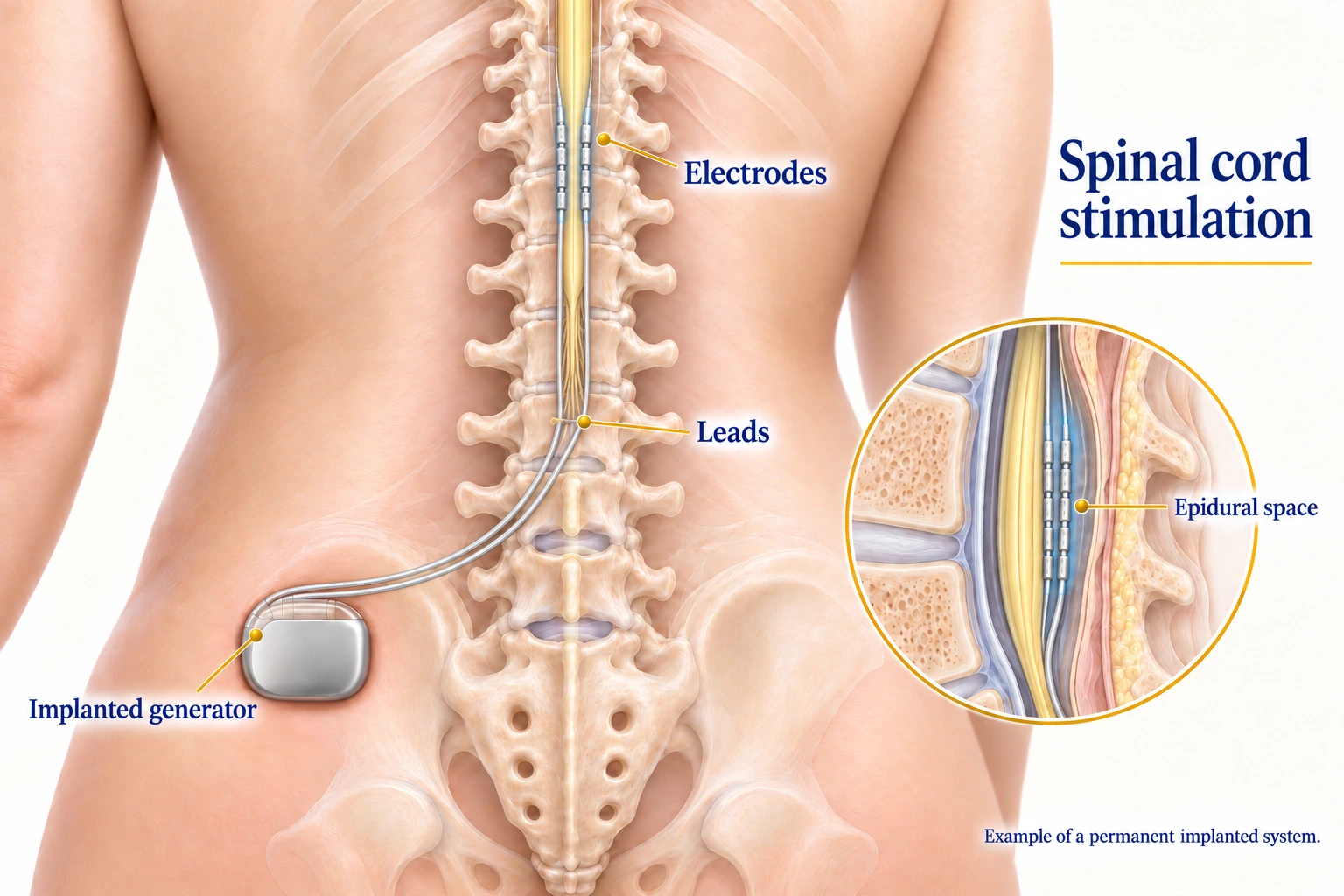
Assessment includes medical suitability, expectations, daily goals, ability to manage the device, and psychosocial screening. A trial usually precedes a permanent implant. The decision should consider pain relief, functional change, tolerability, and the experience of using the system. A successful trial does not guarantee durable benefit. [9]
Other forms of stimulation may be considered for specific pain mechanisms, but evidence for one device or indication should not be transferred to every postoperative pain pattern. See the peripheral nerve stimulation and restorative neurostimulation guides for separate candidacy discussions.
When is further surgical review needed?
Recurrent compression, suspected infection, nonunion, implant failure, or important instability may warrant surgical reassessment. New neurological deficits can make this urgent. If there is no clear correctable lesion, repeating surgery solely because pain remains may expose a patient to risk without a reliable target. [8]
What does the evidence say?
SCS compared with conventional care
The PROCESS trial randomized 100 patients with persistent, predominantly neuropathic leg pain after lumbar surgery. At six months, 48% receiving SCS plus conventional care versus 9% receiving conventional care alone achieved at least 50% leg-pain relief. The trial was not sham-controlled, and results do not apply equally to every back-pain pattern. Device-related complications were also reported. [10]
Placebo-controlled findings temper expectations
A 2022 randomized crossover trial in 50 patients with chronic radicular pain after lumbar surgery found no significant disability advantage for burst stimulation over placebo stimulation. This does not test every stimulation waveform or patient group, but it shows why outcomes from unblinded studies should not be presented as a guarantee of a device-specific effect. [11]
Stimulation versus repeat surgery
A small older randomized trial found greater treatment success with SCS than reoperation in selected patients with persistent radicular pain after lumbosacral surgery. Its size, selection criteria, crossover, and era limit broad conclusions. It does not establish that stimulation is preferable when a patient has an urgent or clearly correctable surgical problem. [12]
There is no universally superior treatment for pain after surgery. The most useful comparison is between options for the same identified problem. Results for neuropathic leg pain should not be used to promise relief of mechanical pain from a nonunion or every type of axial back pain.
Device risks and ongoing care
SCS can cause infection, bleeding, dural puncture, unwanted stimulation, lead migration, device discomfort, loss of benefit, or need for revision or removal. Rare neurological injury is possible. Device-specific MRI conditions, charging or battery replacement, programming, and follow-up need discussion before implantation. [9]
Regardless of treatment, assess progress in walking, sleep, work, self-care, and medication burden as well as pain. New or changing symptoms deserve a fresh review.
Questions patients often ask
Does persistent pain mean the surgery failed?
No. The original operation may have addressed its intended problem while another source remained or developed. Persistent symptoms still deserve investigation and a clear explanation. [2]
Does scar tissue on MRI explain my pain?
Not necessarily. Postoperative scar is common. Its location and relationship to the current symptoms need review, along with other possible explanations. [3]
Will a spinal cord stimulator fix the spine?
SCS aims to change pain signaling. It does not decompress a nerve, repair a fusion, or correct instability. Those questions need to be addressed during evaluation.
Can pain come from a joint outside the operated level?
Yes. Facet, sacroiliac, hip, and adjacent-level problems can coexist. A focused examination and selected testing help avoid attributing everything to the operated site. [4]
What should I bring to an evaluation?
Bring operation reports, relevant imaging, the implant or device information if available, a medication list, and a short record of what helped or worsened each symptom.
References and further reading
Clinical trials, consensus guidance, and patient information supporting this guide.
- National Library of Medicine (NIH). Spine Surgery—Discharge. MedlinePlus Medical Encyclopedia. Read recovery and warning-sign guidance.
- Thomson S, et al. The Implementation of Persistent Spinal Pain Syndrome (PSPS): Mechanism-Based Recommendations. Read the terminology and mechanism recommendations.
- van de Minkelis J, et al. Persistent spinal pain syndrome type 2. Pain Pract. 2024;24:919–936. doi:10.1111/papr.13379. View the clinical review.
- Liliang PC, et al. Sacroiliac joint pain after lumbar and lumbosacral fusion: findings using dual sacroiliac joint blocks. Pain Med. 2011;12:565–570. Read the diagnostic study.
- American College of Radiology. ACR Appropriateness Criteria: Low Back Pain. Read the imaging criteria · Patient summary.
- Dillingham TR, et al. Evaluation of persons with suspected lumbosacral and cervical radiculopathy: electrodiagnostic assessment and implications for treatment and outcomes (Part I). Muscle Nerve. 2020;62:462–473. Read about EMG interpretation.
- Archer KR, et al. Cognitive-behavioral-based physical therapy for patients with chronic pain undergoing lumbar spine surgery: a randomized controlled trial. J Pain. 2016;17:76–89. Read the rehabilitation trial.
- Tronnier VM, et al. The appropriate management of persisting pain after spine surgery: a European panel study with recommendations based on the RAND/UCLA method. Read the multidisciplinary recommendations.
- Shanthanna H, et al. Evidence-based consensus guidelines on patient selection and trial stimulation for spinal cord stimulation therapy for chronic non-cancer pain. 2023. Read the selection and trial guidelines.
- Kumar K, et al. Spinal cord stimulation versus conventional medical management for neuropathic pain: a multicentre randomised controlled trial in patients with failed back surgery syndrome. Pain. 2007;132:179–188. Read the PROCESS trial.
- Hara S, et al. Effect of spinal cord burst stimulation vs placebo stimulation on disability in patients with chronic radicular pain after lumbar spine surgery: a randomized clinical trial. JAMA. 2022;328:1506–1514. Read the placebo-controlled trial.
- North RB, et al. Spinal cord stimulation versus repeated lumbosacral spine surgery for chronic pain: a randomized, controlled trial. Neurosurgery. 2005;56:98–106. Read the comparative trial.
- American Association of Neurological Surgeons. Cauda Equina Syndrome. Read about emergency symptoms.
Updated October 22, 2026. Educational information; treatment decisions require an individual medical evaluation.