

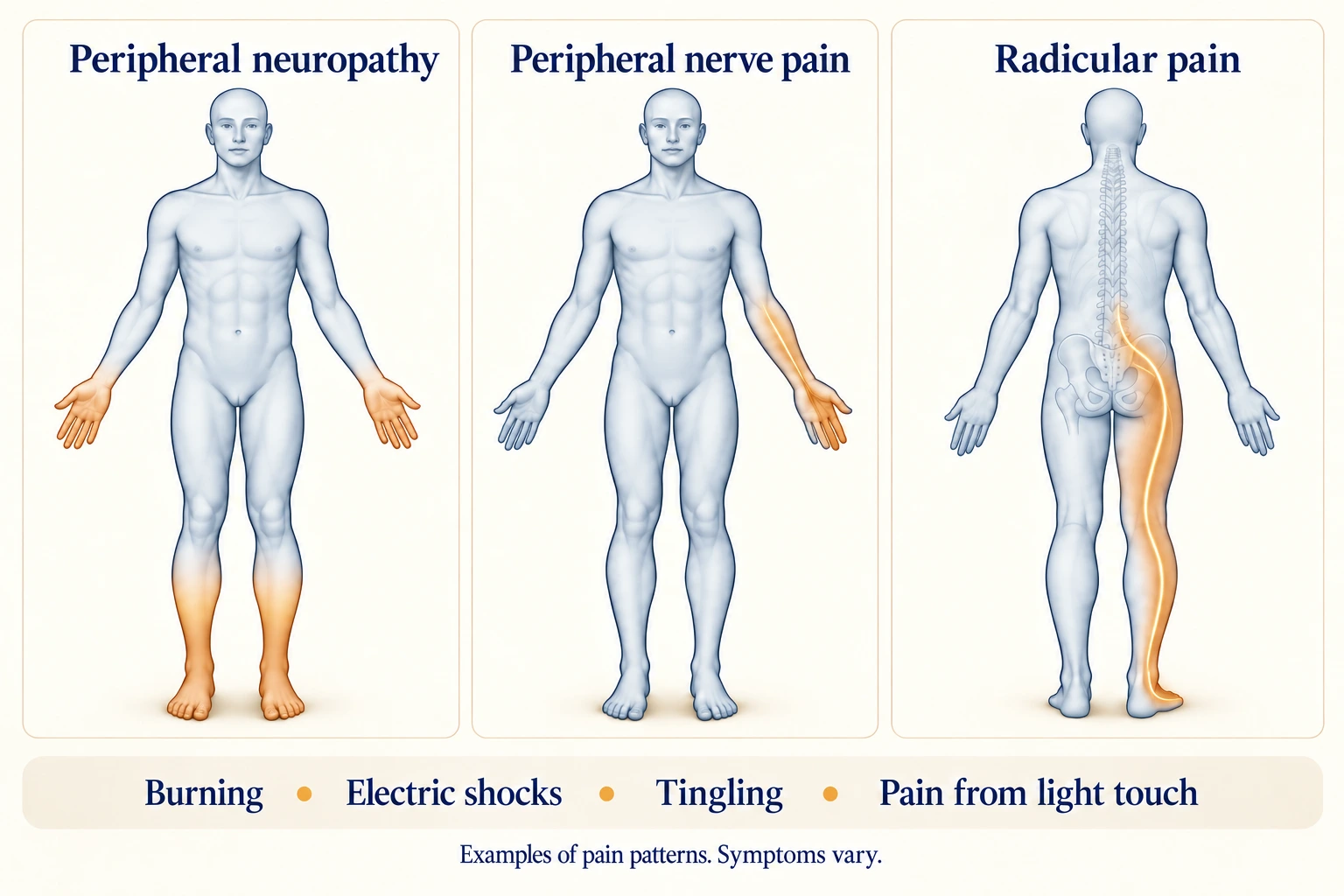
These examples show different distributions of nerve-related symptoms. A symptom pattern is a starting point for evaluation, rather than a diagnosis by itself.
What is neuropathic pain?
Neuropathic pain results from injury or disease affecting the system that carries and processes sensation. It can arise in peripheral nerves, nerve roots, the spinal cord, or the brain. It differs from pain generated by an inflamed joint or strained muscle, although both mechanisms can be present together. [1]
The word “neuropathic” describes a mechanism; it does not identify the underlying disease. A useful diagnosis also asks where the problem is and what caused it. Burning or electric pain can raise suspicion, but those words alone do not establish nerve damage. [2]
Why can a painful area also feel numb?
An affected sensory pathway may lose some normal function while also producing abnormal pain signals. Someone may have reduced sensation in the toes yet find socks or bed sheets uncomfortable. Pain from a normally harmless touch is called allodynia; an unusually strong response to a painful stimulus is called hyperalgesia. Neither finding, by itself, determines the cause. [1]
Some neuropathies are painless. Likewise, severe pain does not reliably measure how much nerve damage is present. Changes in strength, balance, sensation, and everyday function matter alongside the pain score. [3]
The distribution helps narrow the possibilities
Describe the exact location, when symptoms began, and whether they are spreading. Note numbness, weakness, changes in balance, and sensitivity to clothing or touch.
| Pattern | What it may suggest | What needs clarification |
|---|---|---|
| Pain down an arm or leg | A nerve root problem, particularly when the examination and imaging agree. | Radicular pain can overlap with joint or muscle pain; radiating pain is not always a pinched nerve. |
| A defined patch or nerve territory | A focal peripheral nerve injury or entrapment, sometimes after trauma or surgery. | The involved nerve, any weakness, and whether pressure or a structural lesion is present. See focal sensory neuropathies. |
| Both feet, sometimes later the hands | A length-dependent polyneuropathy, including diabetic neuropathy. | Diabetes is one possibility; medication exposure, nutritional, metabolic, and other causes may need evaluation. |
| Pain after shingles | Postherpetic neuralgia when pain continues in the affected skin distribution. | Distinguish ongoing infection or another skin condition from persistent nerve pain. |
| Symptoms after brain or spinal cord disease | Central neuropathic pain in selected patients, such as after stroke or spinal cord injury. | A neurological assessment connecting the sensory symptoms to the known lesion. |
These patterns guide assessment but can overlap. A person may have a peripheral neuropathy and lumbar stenosis at the same time; one diagnosis need not explain every symptom. [2] [3]
Where does CRPS fit?
Complex regional pain syndrome can involve regional pain with swelling, temperature or color differences, sweating changes, and movement difficulty after an injury. A painful or sensitive limb alone is insufficient for the diagnosis. CRPS type II follows an identifiable nerve injury; type I does not require one. CRPS therefore should not be treated as synonymous with every neuropathic pain condition. [4]
How is the diagnosis evaluated?
Assessment combines the history with a neurological examination: mapping altered sensation, checking strength and reflexes, and observing gait and balance. Screening questionnaires can flag a neuropathic component, but cannot replace this assessment. Diagnostic confidence increases when the distribution, examination, and a relevant nerve lesion or disease fit together. [2]
Testing should answer a specific question
- EMG and nerve conduction studies: help identify many large-fiber nerve disorders and distinguish a nerve root problem from a peripheral nerve problem.
- Small-fiber assessment: routine electrical studies can be normal in isolated small-fiber neuropathy. Selected patients may need skin biopsy or autonomic testing. [12]
- Imaging: MRI or nerve ultrasound may be useful when compression, a focal injury, or another structural cause is suspected.
- Laboratory evaluation: the clinical pattern guides testing for potentially treatable causes, such as glucose abnormalities or vitamin B12 deficiency.
A normal EMG does not exclude every sensory nerve disorder, and an abnormal scan does not prove that a finding causes pain. Results must be interpreted in context. [3]
Bring a short symptom history
Mark the painful and numb areas on a body outline. Bring prior tests, a medication and supplement list, and a record of treatments: what improved, what did not, and which side effects occurred. Mention falls, wounds you did not feel, and tasks that have become difficult.
What can treatment achieve?
Address the cause and support daily function
Where possible, treatment addresses the condition affecting the nerve—for example, managing diabetes, correcting a confirmed deficiency, reviewing a potentially harmful exposure, or evaluating a treatable compression. The chance of nerve recovery depends on the cause, severity, and duration; symptom control and recovery are separate outcomes. [3] [10]
Rehabilitation can focus on safe movement, balance, strength, pacing, and tolerating everyday activities. Sleep care and pain-focused coping skills can help patients participate in recovery. These approaches belong alongside appropriate medical evaluation. [1]
Medication choices require a plan for review
Common options include selected antidepressant and antiseizure medicines, as well as topical treatments for some localized peripheral pain conditions. Their use for nerve pain does not imply that pain is imaginary or that a patient has depression or epilepsy. Benefit is often partial, so the aim is worthwhile improvement with acceptable side effects. [5]
| Approach | When it may help | Important limits or risks |
|---|---|---|
| Duloxetine or another selected antidepressant | Some peripheral neuropathic pain conditions; sleep, mood, and other health conditions influence selection. | Nausea, interactions, and other drug-specific effects need review. Some agents can cause sedation, blood-pressure changes, or falls. |
| Gabapentin or pregabalin | Selected neuropathic pain conditions when the expected benefit fits the diagnosis. | Dizziness, sleepiness, swelling, and kidney-based dose adjustment. Respiratory risk rises with opioids or other sedatives and in vulnerable patients. |
| Topical lidocaine or capsaicin | Selected localized peripheral pain; the indication and product matter. | Skin irritation or burning. Prescription high-concentration capsaicin requires supervised application; topical products are not interchangeable. |
| Targeted procedures or surgical review | A specific nerve root, entrapment, or structural problem that matches the symptoms. | A block may provide temporary information or relief, but does not prove long-term success. Procedures do not treat every neuropathy. |
| Spinal cord stimulation | Selected persistent pain despite appropriate care, including some painful diabetic neuropathy and postsurgical pain. | An implanted device with infection, bleeding, lead movement, revision, and loss-of-benefit risks; it does not correct all causes. |
| Peripheral nerve stimulation | Selected focal pain with an identifiable peripheral nerve target. | Evidence and candidacy vary by condition and system. It is not a general treatment for all widespread neuropathies. |
Medication selection should account for kidney function, falls, heart conditions, other medicines, and the actual diagnosis. Do not increase or stop a prescribed medicine abruptly without guidance; some require a gradual taper. The FDA specifically warns about breathing problems with gabapentin and pregabalin in patients with respiratory risk factors. [6]
For painful diabetic polyneuropathy, the American Academy of Neurology recommends assessing benefit and tolerability, considering a different medication class when needed, and avoiding opioids for this condition. Evidence from diabetic neuropathy should not automatically be applied to every cause of radiating limb pain. [7]
When is neuromodulation considered?
The clinician first confirms the pain pattern, reviews treatable causes, and discusses previous care and realistic goals. Spinal cord stimulation uses electrical stimulation near the spinal cord; peripheral nerve stimulation targets a selected nerve outside the spine. The choice depends on the diagnosis and anatomical target. [8] [9]
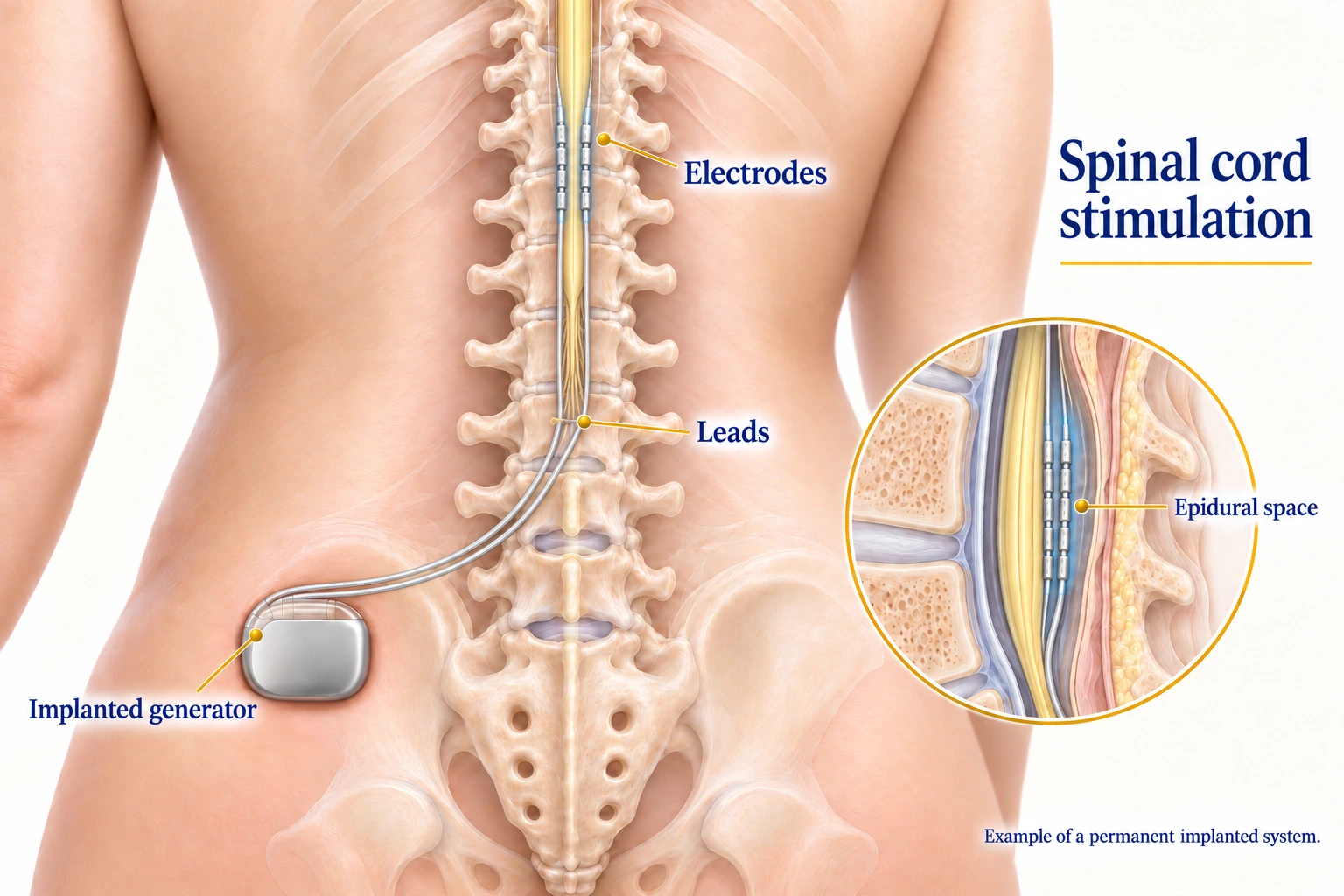
For an implant-based pathway, a trial commonly precedes a permanent implant. Screening includes physical and psychological factors, infection and bleeding risks, ability to manage the device, and MRI requirements. A successful trial can support proceeding, but cannot guarantee lasting relief. [8]
Agree on concrete goals—such as sleeping with fewer awakenings, wearing shoes more comfortably, or walking safely—before treatment. Review pain, activity, side effects, and device burden together. Reduced pain should not be taken as proof of nerve regeneration.
Protect areas with reduced sensation
Check insensate skin regularly, use appropriate footwear, and avoid heating pads or extreme temperatures on numb areas. For diabetic neuropathy, foot checks and professional foot care remain necessary even when pain improves. Report a new sore, redness, swelling, or a wound that is not healing. [10]
What does research show?
Medication guidance supports individualized trials
The NeuPSIG review supports several commonly used drug classes, while showing that benefit is often modest and varies between people. There is no single medicine that reliably works best for everyone. Diabetic neuropathy guidance adds condition-specific advice on switching classes and monitoring sleep and mood. [5] [7]
Spinal cord stimulation: evidence in a defined population
The 216-patient SENZA-PDN randomized trial studied refractory painful diabetic neuropathy. At three months, the primary endpoint—at least 50% pain relief without worsening baseline neurological deficits—was met by 79% with 10-kHz stimulation plus medical care versus 5% with medical care alone. [11]
This open-label, industry-funded trial supports consideration in selected patients. It was not a blinded comparison, did not compare every device, and does not establish a cure or prove benefit for all neuropathies. Implant-related complications, including infections requiring removal, occurred.
Peripheral nerve stimulation needs a matching target
Consensus guidance supports selective use after a diagnostic assessment. The strength of evidence differs across pain conditions, nerve targets, and devices; results from one application cannot establish superiority for another. Discuss the evidence for your particular diagnosis, rather than only the technology. [9]
No procedure is universally superior. A treatment for a compressed nerve, focal peripheral nerve pain, and diffuse diabetic neuropathy answers different clinical questions. Compare expected benefit, alternatives, risks, maintenance, and the effect on daily life.
Common questions
Does burning pain always mean nerve damage?
No. It is a useful clue, but other pain mechanisms can produce similar descriptions. The distribution, history, examination, and selected tests help establish whether a nerve lesion or disease is involved.
Can my EMG be normal even if I have nerve pain?
Yes. Standard studies mainly evaluate large nerve fibers and motor-unit changes. Isolated small-fiber neuropathy and some sensory conditions may not appear on routine EMG and nerve conduction testing. The next step depends on the clinical findings.
Will less pain mean the nerve has healed?
Not necessarily. Medicines and stimulation can reduce pain signaling without repairing the original lesion. Sensation, strength, balance, and skin protection need separate follow-up.
Is all pain after spine surgery neuropathic?
No. Persistent symptoms can include nerve pain, joint pain, muscle dysfunction, or several contributors together. Read the pain after spine surgery guide for how these are evaluated.
Does nerve pain mean I need an implant?
No. Many people are treated with care for the underlying condition, rehabilitation, medication, or selected topical therapies. An implant is considered only for an appropriate diagnosis after discussing alternatives, likely benefit, and risks.
What if the first medicine does not help?
Review the dose, duration, diagnosis, and adverse effects with the prescriber. A different class or another approach may be appropriate. Avoid continuing an ineffective medicine indefinitely or changing treatment abruptly on your own.
References and further reading
Definitions, clinical guidance, and trial data supporting this guide.
- International Association for the Study of Pain. An Overview of Neuropathic Pain and Its Impact. 2026. Read the IASP overview.
- Finnerup NB, et al. Neuropathic pain: an updated grading system for research and clinical practice. Pain. 2016;157:1599–1606. Read the diagnostic framework.
- National Institute of Neurological Disorders and Stroke. Peripheral Neuropathy. Read the NIH guide.
- American Academy of Orthopaedic Surgeons. Complex Regional Pain Syndrome (Reflex Sympathetic Dystrophy). OrthoInfo. Read about CRPS.
- Finnerup NB, et al. Pharmacotherapy for neuropathic pain in adults: a systematic review and meta-analysis. Lancet Neurol. 2015;14:162–173. Read the NeuPSIG evidence review.
- U.S. Food and Drug Administration. Gabapentin and Pregabalin: Drug Safety Communication. 2019. Read the medication safety information.
- Price R, et al. Oral and Topical Treatment of Painful Diabetic Polyneuropathy: Practice Guideline Update Summary. Neurology. 2022;98:31–43. Read the AAN guideline.
- Shanthanna H, et al. Evidence-based consensus guidelines on patient selection and trial stimulation for spinal cord stimulation therapy for chronic non-cancer pain. Reg Anesth Pain Med. 2023;48:273–287. Read the selection and trial guidance.
- Latif U, et al. Consensus Guidelines for the Use of Peripheral Nerve Stimulation in the Treatment of Chronic Pain and Neurological Diseases: A Neuron Project from the American Society of Pain and Neuroscience. J Pain Res. 2025;18:5949–5990. Read the PNS consensus guidance.
- National Institute of Diabetes and Digestive and Kidney Diseases. Peripheral Neuropathy. Read about diabetes and nerve care.
- Petersen EA, et al. Effect of High-frequency (10-kHz) Spinal Cord Stimulation in Patients With Painful Diabetic Neuropathy: A Randomized Clinical Trial. JAMA Neurol. 2021;78:687–698. Read the SENZA-PDN trial.
- University of Rochester Medical Center. Skin Biopsy, Cutaneous Innervation Laboratory. Read about small-fiber testing.
Updated October 22, 2026. Educational information; diagnosis and treatment require an individual medical evaluation.